
 日本語
Bid History
|
mrtierney50
2026/10/25 (Sun) 11:00 |
¥2,500,000 |
|
Auction started
2026/10/24 (Sat) 12:24 |
|
※ = Auto
Ordering Number: AS26532
Katana in Shirasaya(NBTHK Hozon Token)
Inscription:
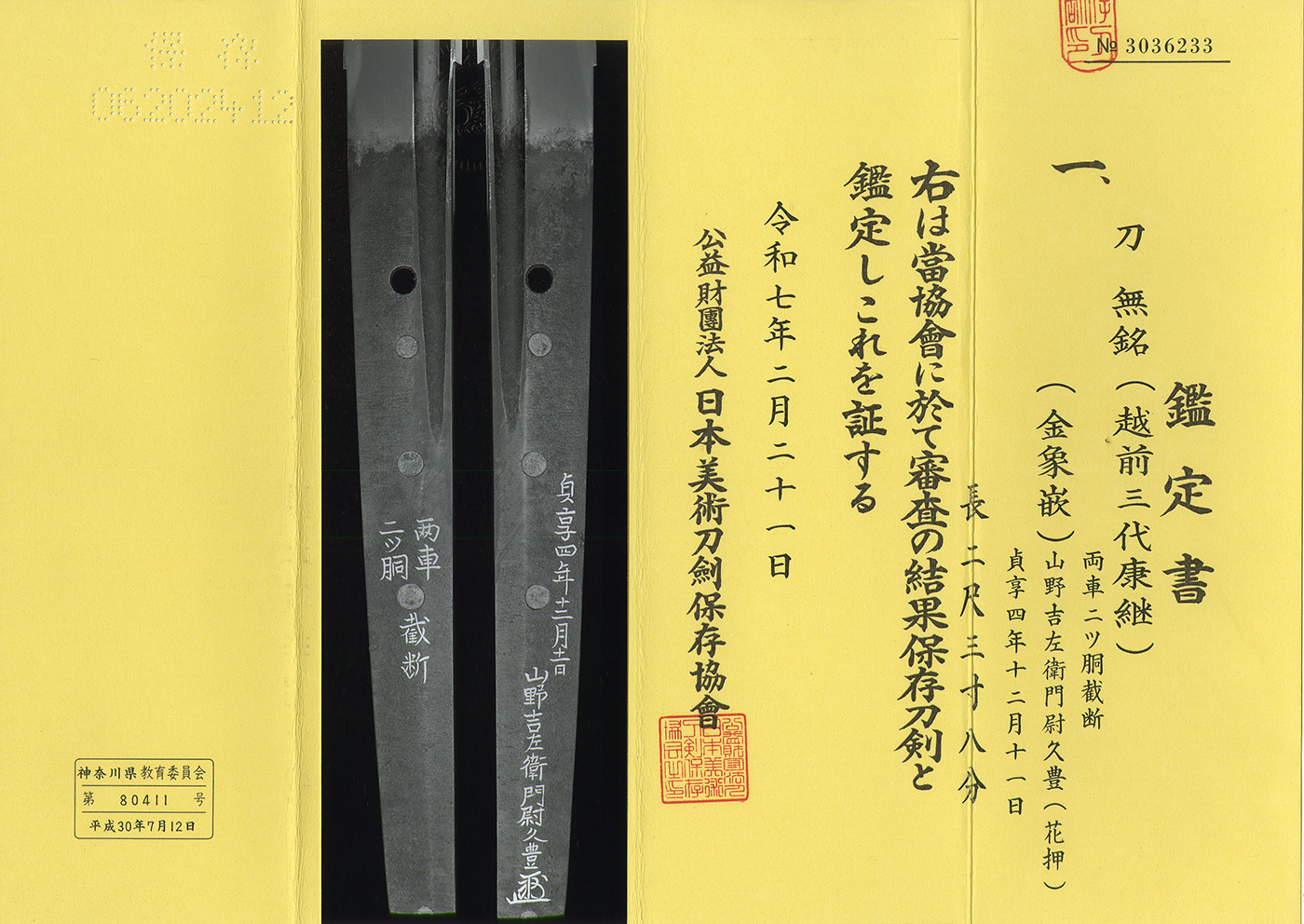
Mumei(Unsigned)(Echizen 3th gen Yasutsugu 越前康継)
(Golden insription):
Ryoguruma Futatsudo Saidan 両車二ツ胴裁断
Yamano Kichizaemon Hisatoyo(written seal mark)
山野吉左衛門尉久豊
Jokyo Yo-nen Juni-gatsu Juichi-nichi
貞享四年十二月十一日
Wazamono: Jyo Saku: Musashi province: Kanbun era.
We divide works in to Saijo Saku, Jyojyo Saku, Jyo Saku,and Regular Saku.
This piece is ranked as Jyojyo Saku for Mumei(Echizen 3th gen Yasutsugu).
Habaki: Single silver habaki.
Blade Length: 72.0 cm (28.35 in).
Curvature: 1.7 cm (0.67 in).
Mekugi Hole: 4 (3 filled).
Width at Base (Motohaba): 3.14 cm (1.24 in).
Width at Yokote: 1.99 cm (0.78 in).
Thickness of rim (Kasane): 0.93 cm (0.37 in).
Sword Weight: 790 g.
Era: Edo period.
Shape: The blade has been shortened (suriage) and has undergone machi-okuri (relocation of the notches at the base of the blade).
Jigane: Well-forged itame hada.
It is believed that Nanban-tetsu (imported foreign iron) may have been used in the forging of this blade.
Hamon: Notare with abundant kinsuji.
Features: The 3rd-generation Echizen Yasutsugu was the 3rd son of the 1st-generation Yasutsugu.
He was initially known as Shiroemon and later adopted the name Ichiemon.
Following the death of his elder brother, the 2nd-generation Yasutsugu, the family lineage divided into 2 branches, one based in Echizen and the other in Edo, with both successors assuming the title of 3rd-generation Yasutsugu.
His workmanship faithfully followed the traditions established by the 1st and 2nd generations, and he produced highly regarded blades.
He passed away in January 1683 (Tenna 3).
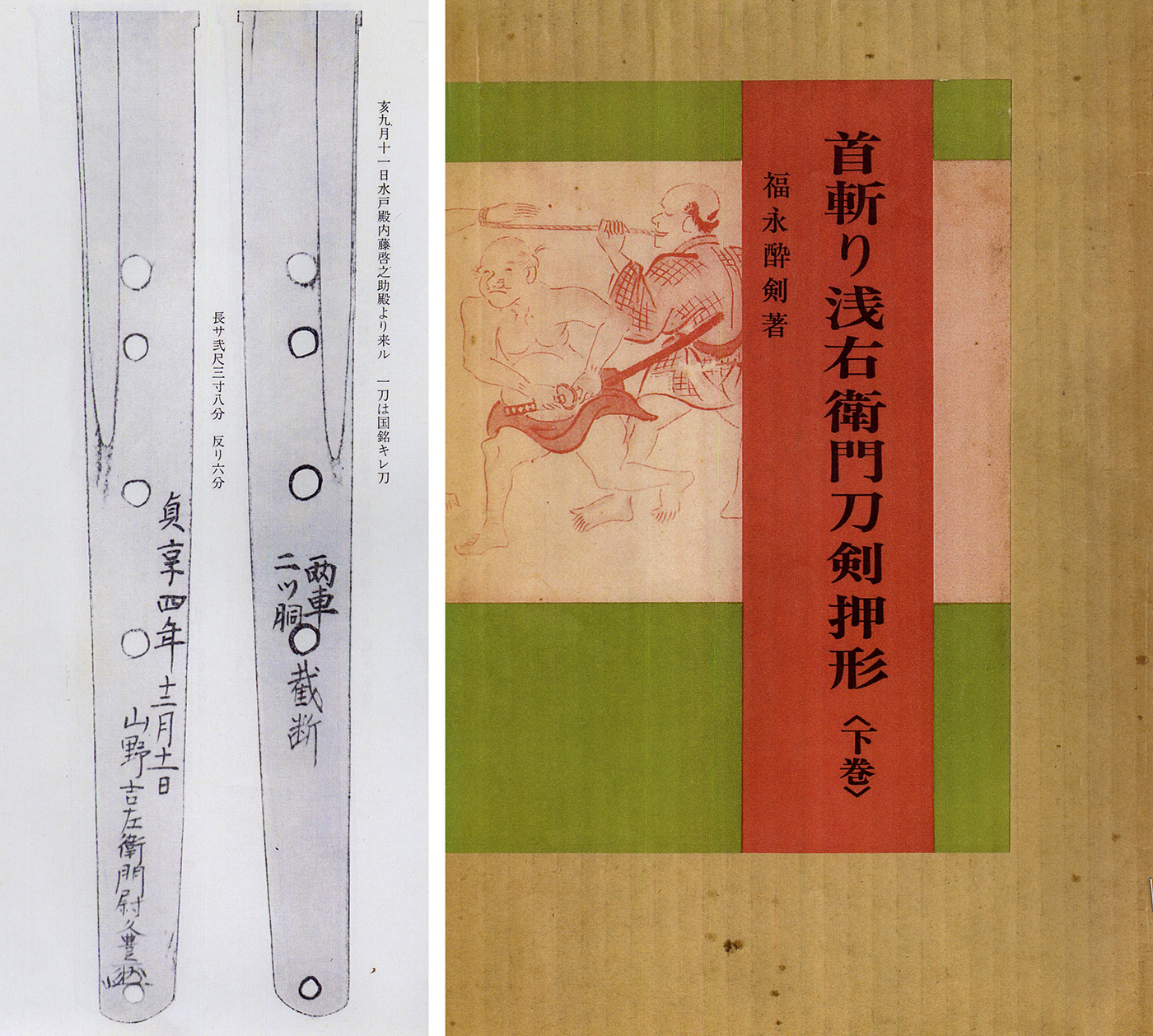
A historical record survives documenting a cutting test performed on January 13, 1688 (December 11, 1687, according to the Japanese lunar calendar), by Yamano Kizaemon no Jo Hisatoyo, a sword-testing official serving the Edo shogunate, whose signature and kao (personal seal) appear in the record.
The saidan-mei (cutting-test inscription) records the results of a cutting test conducted using the bodies of executed criminals.
The term Futatsu-do indicates that the sword successfully cut through 2 stacked bodies with a single stroke.
Ryoguruma refers to the pelvic region, which was considered particularly difficult to cut through because of the large and substantial bones.
This sword is distinctive for its greater-than-average length and pronounced curvature.
It is illustrated in the lower volume of Kubikiri Asaemon Token Oshigata (Sword Oshigata of Kubikiri Asaemon).
Historical Background: The Jokyo era (1684–1688) fell during the reign of Tokugawa Tsunayoshi, the 5th shogun of the Tokugawa shogunate.
Tsunayoshi is particularly well known for the Shorui Awaremi no Rei (Edicts on Compassion for Living Things), which included measures to protect stray dogs.
For many years, he was portrayed as an incompetent ruler whose excessive concern for animal welfare placed a heavy burden on ordinary people.
However, modern historical interpretations have also emphasized the social welfare aspects of his policies, including prohibitions against abandoning infants and measures to protect the sick and vulnerable.
These reforms are considered by some historians to have represented an effort to transform the values of samurai society, which had inherited a culture of violence and killing from the Sengoku period.
NBTHK Hozon Certificate
Aoi-Art estimation Paper
whole Oshigata
Please note: the price does not include the shipping fees.



Current bid: ¥2,500,000
|
mrtierney50
2026/10/25 (Sun) 11:00 |
¥2,500,000 |
|
Auction started
2026/10/24 (Sat) 12:24 |
|
※ = Auto