
 日本語
日本語Bid History
|
Auction started
2026/10/07 (Wed) 14:07 |
※ = Auto
Ordering Number: AS25338
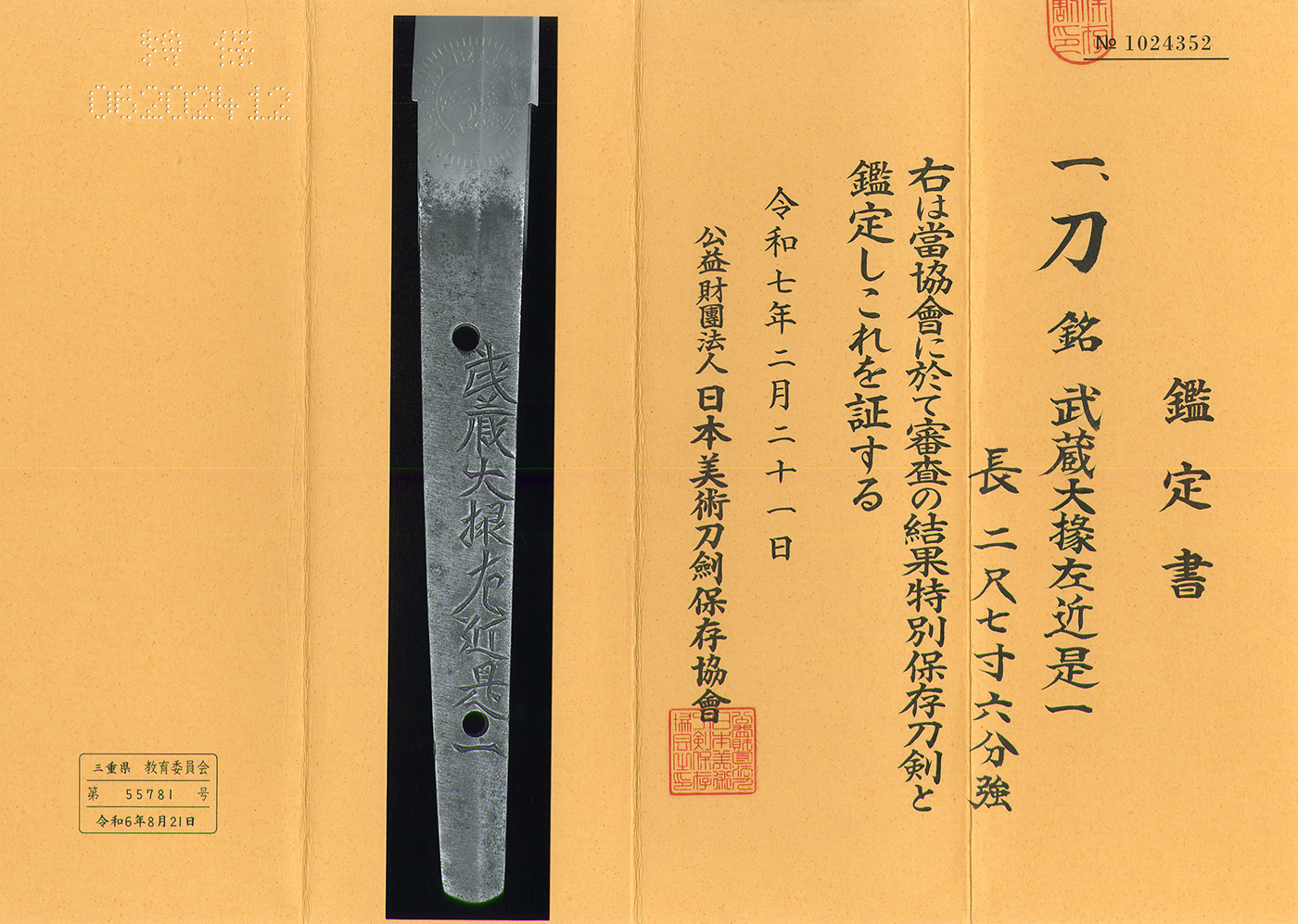
Katana in Shirasaya with Koshirae (NBTHK Tokubetsu Hozon Token)
Signature: Musashi Daijō Sakon Korekazu (First Generation)
武蔵大掾左近是一(初代)
Shinto: Jyo Saku: Ryo Wazamono: Musashi
(We divide 4 sections for each sword as Saijyo Saku, Jyojyo Saku, Jyo Saku and Regular Saku).
This blade is ranked as Jyojyo Saku among the works of Musashi Daijō Sakon Korekazu.
Habaki: Single silver habaki.
Blade Length: 83.7 cm (32.95 in).
Curvature: 2.0 cm (0.79 in).
Mekugi Hole: 1.
Width at Base (Motohaba): 3.25 cm (1.28 in).
Width at Yokote: 2.05 cm (0.81 in).
Thickness of rim (Kasane): 0.68 cm (0.27 in).
Sword Weight: 945 g.
Era: Around the Manji era (1658–1661), Edo period.
Shape: An exceptionally long katana with relatively shallow curvature and a slightly elongated kissaki.
Jigane: A refined jigane with fine masame hada visible throughout.
Hamon: Nie-deki gunome-midare with active kinsuji and abundant ko-ashi. The boshi enters midare.
Features: Musashi Daijō Sakon Korekazu, also known as Kawakami Sakon, was born in Gamo District, Ōmi Province. He belonged to the Ōmi Ishidō school before later moving to Edo. Among the distinguished swordsmiths active in Musashi at the time were Dewa no Kami Mitsuhira, Tsushima no Kami Tsunemitsu, and Taitō Ren, all of whom competed to produce blades of exceptional quality. The Fukuoka Ishidō school also forged works inspired by the famous Ichimonji tradition.
This blade measures an impressive 83.7 cm (32.95 in) in length, with a substantial mihaba and kasane. Although forged with masame hada, the grain flows naturally and is not overly conspicuous. It is an excellent example, worthy of its Jyojyo Saku ranking.
Koshirae:
Tsuba: Round iron tsuba with openwork carving of bundled noshi (ceremonial folded-paper ornaments).
Fuchi: Iron carved with plant motifs and decorated with gold iroe.
Kashira: Horn (?).
Kojiri: Iron decorated with plant motifs in gold.
Saya (Scabbard): Black lacquered saya.
Menuki: None.
Historical Background: Around the Keian era (1648), the Edo shogunate promulgated the Regulations for the City of Edo, reinforcing fire prevention measures and public order through detailed regulations governing both townspeople and samurai. The government also strengthened economic controls over the farming population by prohibiting the leasing of farmland, thereby protecting the agricultural base upon which the land tax system depended.
NBTHK Tokubetsu Hozon Token.
AoiArt estimation paper: Whole Oshigata.
Overseas shipping is charged separately.
Please note: The price does not include the international shipping fees.






Starting bid: ¥1,800,000
|
Auction started
2026/10/07 (Wed) 14:07 |
※ = Auto