
 日本語
日本語Bid History
Auction has expired
Highest bidder was: gorets13
|
gorets13
2026/08/14 (Fri) 04:24 |
¥1,200,000 |
|
Auction started
2026/08/08 (Sat) 11:36 |
|
※ = Auto
Ordering Number: AS26359
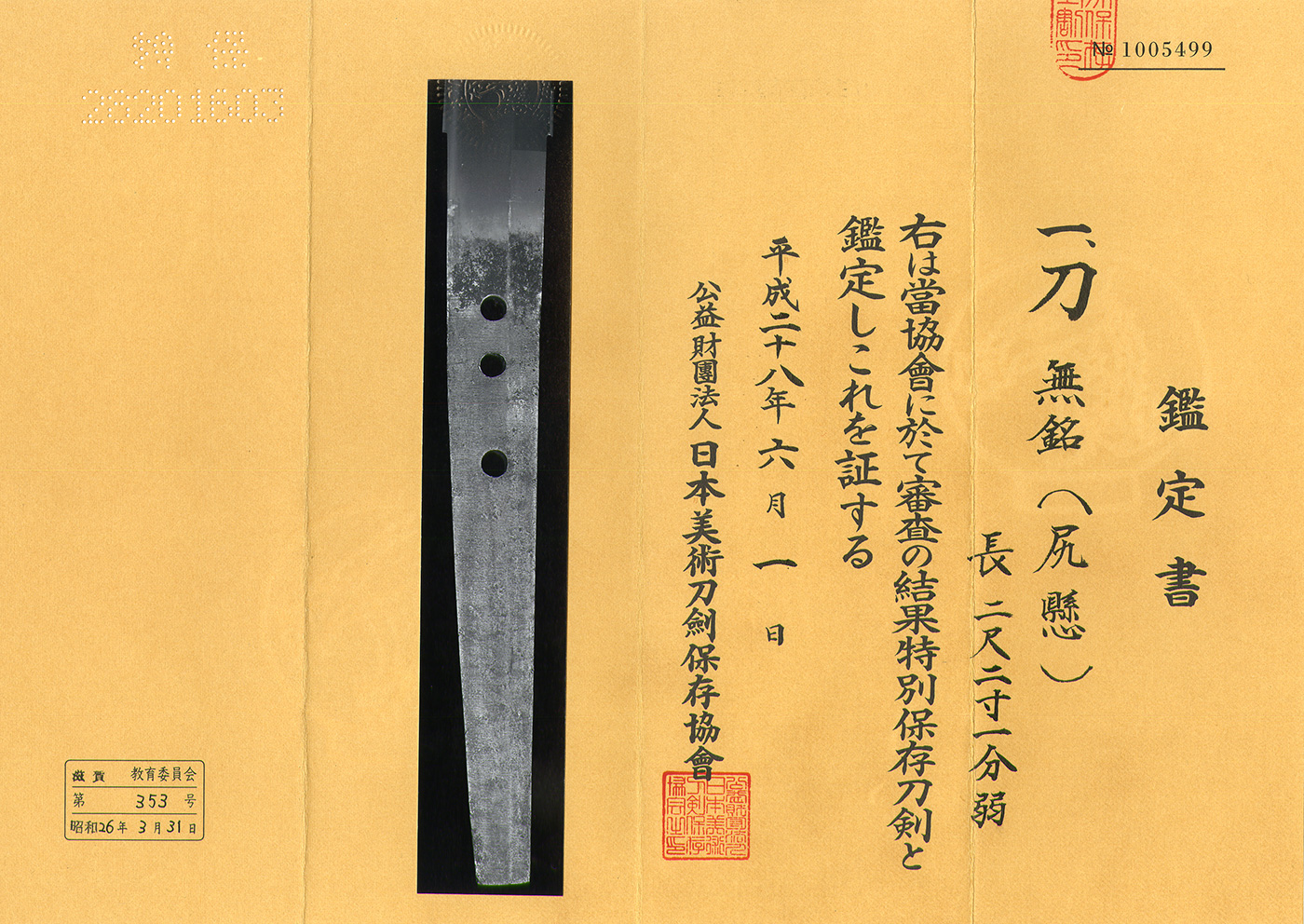
Katana in Koshirae (NBTHK Tokubetsu Hozon Token)
Signature: Mumei (Shikkake)
無銘(尻懸)
(We divide 4 sections for each sword as Saijyo Saku, Jyojyo Saku, Jyo Saku and Regular Saku).
This blade is ranked as Jyojyo Saku among Mumei Suriage Shikkake works.
Habaki: Single silver habaki.
Blade Length: 66.7 cm (26.26 in) (2 shaku 2 sun).
Curvature: 1.5 cm (0.59 in) (5 bu).
Mekugi Hole: 3.
Width at Base (Motohaba): 3.07 cm (1.21 in).
Width at Yokote: 2.05 cm (0.81 in).
Thickness of rim (Kasane): 0.71 cm (0.28 in).
Sword Weight: 715 g.
Era: Kamakura period, around Bunpo (1317).
Shape: An o-suriage mumei katana with normal curvature and a slightly elongated kissaki.
Jigane: Well-forged ko-itame hada with active chikei and visible shirake-utsuri.
Hamon: Nioi-deki suguha with nijuba. Bright ko-ashi are active, while yo work together with the soft double temper line. The boshi becomes slightly irregular before finishing with a hakikake tip.
Features: The Shikkake School, one of the five major Yamato traditions, flourished under Norinaga, who is regarded as its effective founder. Existing tanto signed by Norinaga and inscribed with his age—48 in Bunpo 3 (1319) and 69 in Ryakuo 3 (1340)—indicate that he was born in Bun’ei 7 (1270). Later generations also inherited the same name during the Muromachi period. The characteristic workmanship of the Shikkake School includes a high shinogi, broad mihaba, flowing itame hada, and a suguha-based hamon, all representative of the Yamato tradition. Distinctively, however, the hamon often incorporates conspicuous ko-gunome, giving the school its own unique identity. Although this blade has been o-suriage and additional mekugi-ana have been made over time, the machi-okuri and overall proportions indicate that it was originally forged as a tachi. Its broad construction, high shinogi, flowing itame hada, and suguha mixed with ko-gunome clearly justify its attribution to the Shikkake School.
Koshirae:
Tsuba: Vertically oval tsuba carved with waves and plovers, decorated with gold iroe.
Fuchikashira: Silver ground carved with wave motifs.
Saya (Scabbard): Black lacquered saya.
Menuki: Horse motif in shakudo with gold iroe.
Aoi Art’s Comment: Although a small number of Shikkake blades survive from the mid-Kamakura period, most extant examples date from the late Kamakura period. This sword is considered an excellent example, free from flaws or significant defects. While appreciating this remarkable Shikkake blade, forged approximately 709 years ago, one cannot help but imagine the world in which it was created.
NBTHK Tokubetsu Hozon Token.
AoiArt estimation paper: Whole Oshigata.
Please note: the price does not include the shipping fees.






Winning Bid: ¥1,200,000
Auction has expired
Highest bidder was: gorets13
|
gorets13
2026/08/14 (Fri) 04:24 |
¥1,200,000 |
|
Auction started
2026/08/08 (Sat) 11:36 |
|
※ = Auto