
 日本語
日本語Bid History
Auction has expired
Highest bidder was: msakniyuk
|
msakniyuk
2026/07/10 (Fri) 10:05 |
¥18,000,000 |
|
Auction started
2026/07/03 (Fri) 17:17 |
|
※ = Auto
Ordering Number: AS24595
Wakizashi in Shirasaya(NBTHK Tokubetsu Hozon Token)
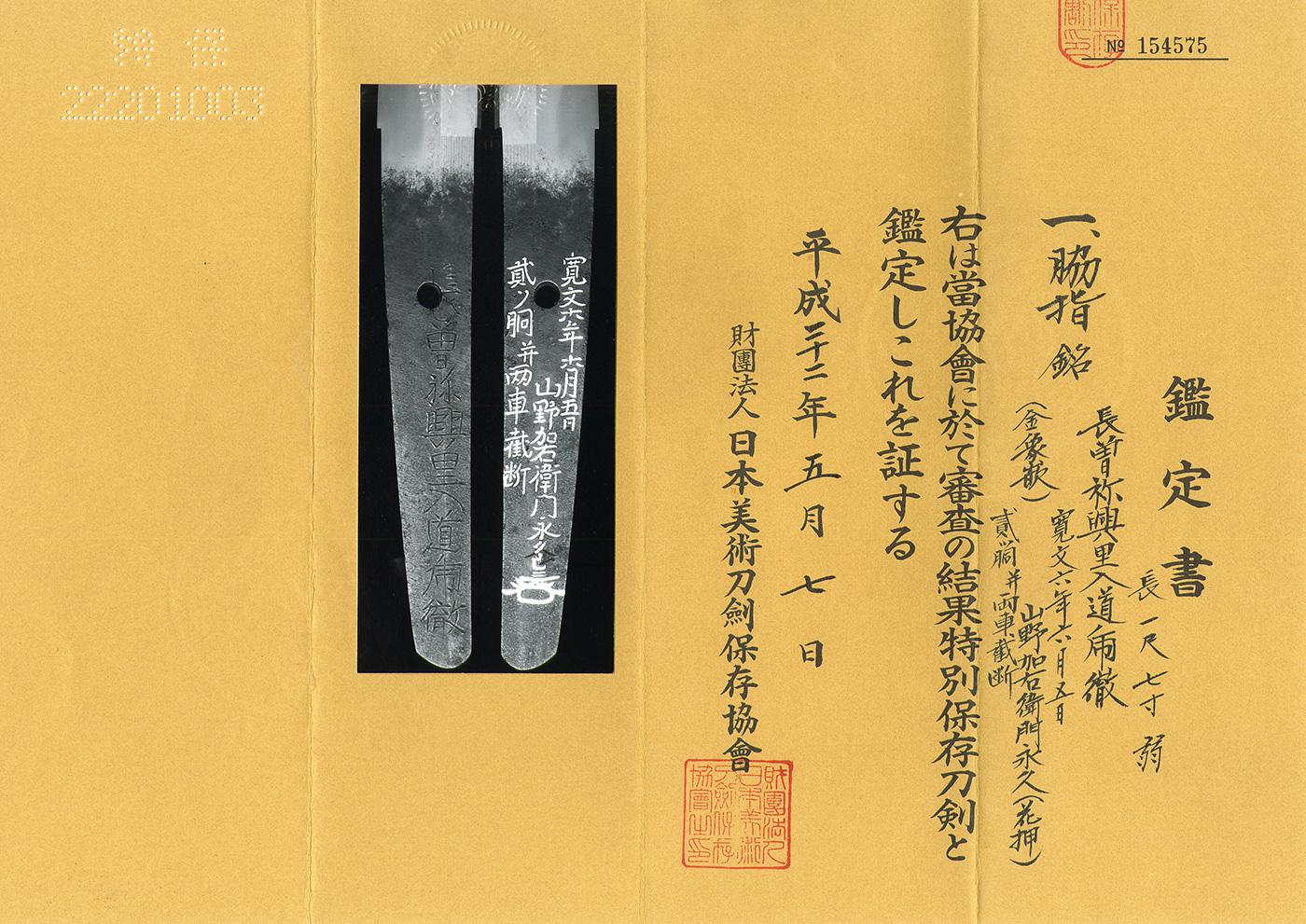
Signature: Nagasone Okisato Nyudo Kotetsu 長曽祢興里入道乕徹
(Golden-inscription):
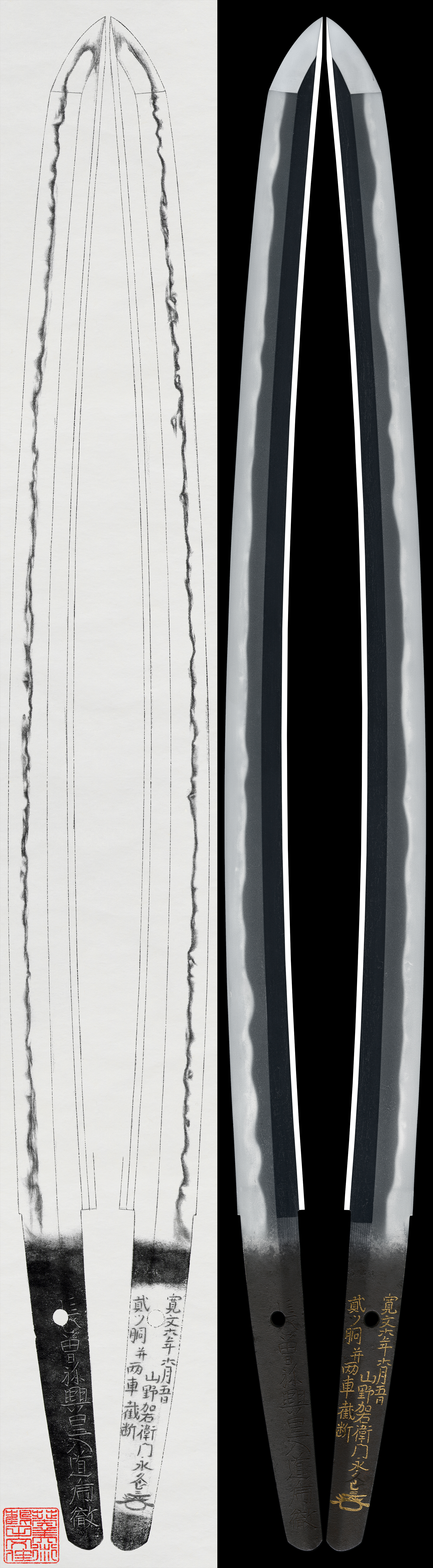
山野加右衛門永久 寬文六年六月五日 弐ツ胴并両車截斷
Yamano Kaemon Nagahisa June 5, Kanbun 6(1666) cut off 2 bodies and Ryoguruma (waist part)
We classify swords based on the craftsmanship into four ranks: Saijo Saku, Jyojyo Saku, Jyo Saku, and Regular Saku.
This sword is ranked as Saijo Saku, the highest level of craftsmanship.
Habaki: Gold-plated double habaki
Blade Length: 51.3cm (20.2in)
Curvature: 1.0cm (0.4in)
Mekugi Hole: 1
Width at Base: 2.8cm (1.1in)
Width at Yokote: 2.1cm (0.8in)
Kasane: 0.5cm (0.2in)
Sword Weight: 470 g
Era: the early Edo period Kanbun 4-6 (1664-1666)
Shape: Normal width and thickness, slightly deeper curvature, extended kissaki.
Jigane: beautiful fine ko-itame hada with jinie.
Hamon: Gunome-midare with nie, featuring small ashi. Boshi is little Notare and rounded.
Features: Shinto: Saijo-Owazamono: Saijo Saku: Musashi
Nagasone Kotetsu Okisato worked as an armor maker in Oumi or Echizen, and switched to swordsmith in Edo aroud the age of 50. His works were considered to have excellent cutting ability, and was desgnated Saijo Owazamono (top-grade) in “Kaiho Kenjyaku(懐宝剣尺)”, a book published in 1797, which describes the results of test cutting of swords. Kotetsu’s works were highly reputed and favored by th high officials of the Shogunate, so many forgeries were made. The character of Kotetsu was changed from “虎徹” to “乕徹” around 1664.
The Golden Inscription is Saidan-mei(cutting inscription). The Saidan-mei describes the result of a trial cutting of the sword. According to the cutting inscription on this work, the sword was cut off at Ryoguruma (両車, pelvic region)of two overlapping bodies in a test cut in 1666 by Yamano Kaemon.
From Aoi-Art: “Ryoguruma” cut off by this sword is the pelvic area, which is said to be hard and difficult to cut because of the bone. I believe that this cutting inscription is a remarkable example of the sharpness of Kotetsu. Test cutting was done in 1666, the same time the sword was made. It is said that the inscription “乕徹” was used after the 1664, so the cutting inscription of this work is from the time when the sword was made, and it can be seen that these cutting inscriptions have enhanced the reputation of Kotetsu since that time. The popularity of Toratoru is extremely high, and it is not easy to find one. We hope you will purchase this item.
NBTHK Tokubetsu Hozon paper
Aoi-Art estimation paper
whole oshigata



Winning Bid: ¥18,000,000
Auction has expired
Highest bidder was: msakniyuk
|
msakniyuk
2026/07/10 (Fri) 10:05 |
¥18,000,000 |
|
Auction started
2026/07/03 (Fri) 17:17 |
|
※ = Auto