
 日本語
日本語Bid History
Auction has expired
Auction Expired because there were no bids|
Auction started
2026/07/03 (Fri) 10:57 |
※ = Auto
Ordering Number: AS26233
Katana in Shirasaya (NBTHK Tokubetsu Hozon Token)
Signature: Mumei (Unsigned) (Hokke School, Nanbokucho Period)
無銘(法華・南北朝)
(We divide 4 sections for each sword as Saijyo Saku, Jyojyo Saku, Jyo Saku and Regular Saku).
This blade is ranked as Jyojyo Saku among works attributed to Mumei (Hokke School, Nanbokucho period).
Habaki: Single-layer silver habaki.
Blade Length: 72.6 cm (28.58 in).
Curvature: 1.8 cm (0.71 in).
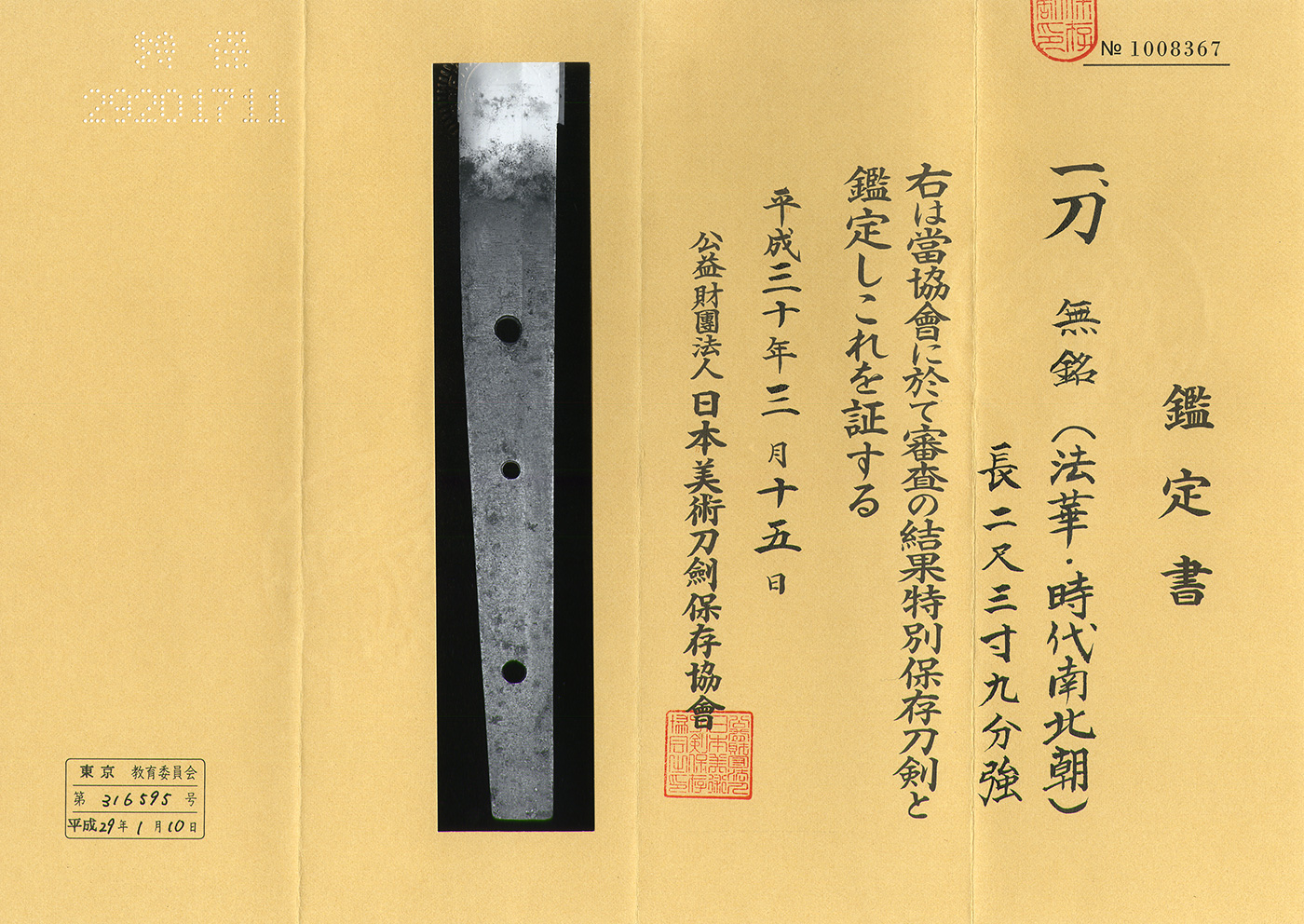
Mekugi Hole: 3.
Width at Base (Motohaba): 2.91 cm (1.15 in).
Width at Yokote: 2.24 cm (0.88 in).
Thickness of rim (Kasane): 0.64 cm (0.25 in).
Sword Weight: 820 g.
Era: Nanbokucho period (1336-1392).
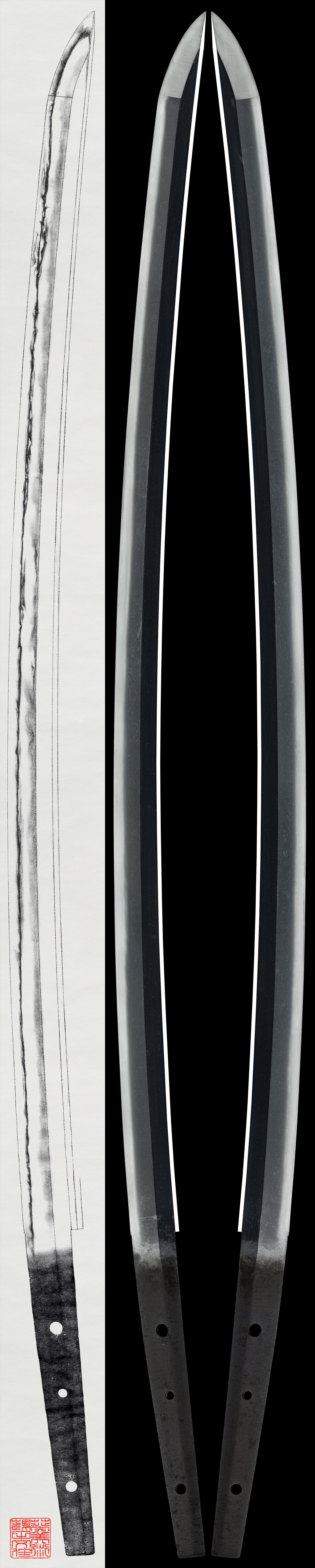
Shape: O-suriage mumei blade with a wide mihaba, deep curvature, and an elongated kissaki, displaying the characteristic proportions of the Nanbokucho period.
Jigane: Well-forged itame mixed with mokume hada, with the grain clearly visible.
Hamon: A rather tight suguha.
The boshi returns in a large komaru.
Features: The term Hokke derives from the Lotus Sutra (Hokekyo), one of the principal scriptures of Mahayana Buddhism, which teaches that all people are equally capable of attaining enlightenment.
The Hokke school, however, refers to a group of swordsmiths rather than the scripture itself.
Although this blade is unsigned, it has been attributed through shinsa to the Hokke school.
The Hokke school flourished from the late Kamakura period through the Nanbokucho and into the Muromachi period.
Its founder is traditionally regarded as Sukekuni of Kokubunji, who is said to have moved from Bizen Province to Bingo Province in the late Kamakura period.
The school’s workmanship combines elements of the Bizen tradition, known for its graceful and decorative hamon, with features of the Yamato tradition, including the presence of masame hada.
This blade exhibits a wide mihaba, substantial kasane, and an elongated kissaki, resulting in an excellent and powerful overall shape.
Historical Background: The Nanbokucho period (1336-1392) was a turbulent era during which Japan was divided between the Northern Court in Kyoto and the Southern Court in Yoshino, with nationwide civil conflict continuing for nearly 60 years.
The conflict arose from the dissatisfaction of the samurai class with Emperor Go-Daigo’s Kenmu Restoration and the subsequent uprising of Ashikaga Takauji.
After Takauji established a rival emperor in Kyoto, Emperor Go-Daigo fled to Yoshino, resulting in the coexistence of two imperial courts for approximately six decades.
NBTHK Tokubetsu Hozon Token.
AoiArt estimation paper: Whole Oshigata.
Please note: The price does not include the international shipping fees.




Auction Expired
Auction Expired because there were no bids
Auction has expired
Auction Expired because there were no bids|
Auction started
2026/07/03 (Fri) 10:57 |
※ = Auto