
 日本語
日本語Bid History
Auction has expired
Auction Expired because there were no bids|
Auction started
2026/09/20 (Sun) 11:14 |
※ = Auto
Ordering Number: AS26464
Katana in Shirasaya with Koshirae (NBTHK Tokubetsu Hozon Token)
Inscription:
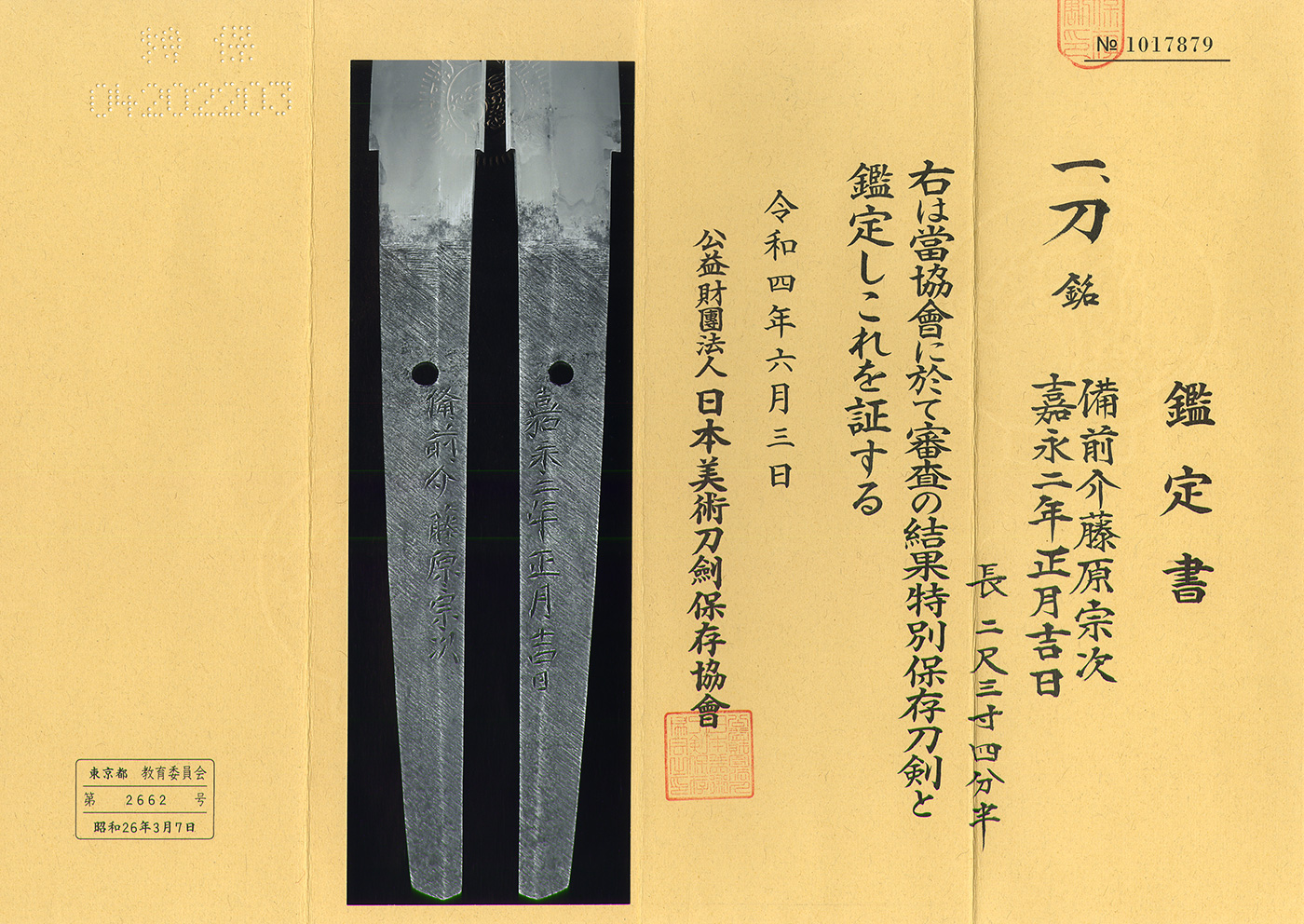
Bizen Suke Fujiwara Munetsugu 備前介藤原宗次
Kaei Ni-nen Shogatsu Kichijitsu 嘉永二年正月吉日 (February1849)
We divide works in to Saijo Saku, Jyojyo Saku, Jyo Saku,and Regular Saku.
This piece is ranked as Jyojyo Saku for Munetsugu.
Habaki: gold plated single habaki
Blade Length: 71.2cm (28.03in)
Curvature: 1.67cm (0.66in)
Mekugi-ana: 1
Motohaba: 3.06cm (1.20in)
Sakihaba: 2.03cm (0.80in)
Kasane: 0.75cm
Weight: 830g
Era: Era: late Edo period 1849
Shape: slightly thin, thick blade taperin toward the tip and long kissaki.
Jigane: Mokume and O-itame with Chikei.
Hamon: Small gunome midare with konie making koashi, yo and kisuji.
Koshirae:
Tsuba: Iron, chrysanthemum design
Fuchikashira: Shakudo nanako-ji, chrysanthemum design
Menuki: Chrysanthemum design
Features:
Features: Bizen no Suke Fujiwara Munetsugu, better known as Koyama Munetsugu, was one of the leading swordsmiths of the late Edo period. He was born in Shirakawa, Mutsu Province, as the third son of Koyama Munehira and later became a retained swordsmith of the Shirakawa Matsudaira family. In 183, he moved to Edo, and in 1845, he was granted the honorary title Bizen no Suke. Swords made during this period are often referred to as “Tenpo-uchi” and are highly prized. The present sword, however, was made in 1849 (Kaei 2), and a rare example among Munetsugu’s works, featuring a boldly patterned jigane with prominent chikei reminiscent of Norishige, making it a particularly valuable and noteworthy work. Despite the boldly patterned jigane, the blade shows no forging flaws demonstrating Munetsugu’s exceptional skill and his meticulous approach to swordmaking.
NBTHK Tokubetsu Hozon Certificate
Aoi-Art estimation Paper
whole Oshigata
Please note: the price does not include the shipping fees.




Auction Expired
Auction Expired because there were no bids
Auction has expired
Auction Expired because there were no bids|
Auction started
2026/09/20 (Sun) 11:14 |
※ = Auto