
 日本語
日本語Bid History
Auction has expired
Auction Expired because there were no bids|
Auction started
2026/06/16 (Tue) 14:03 |
※ = Auto
Ordering Number: AS26236
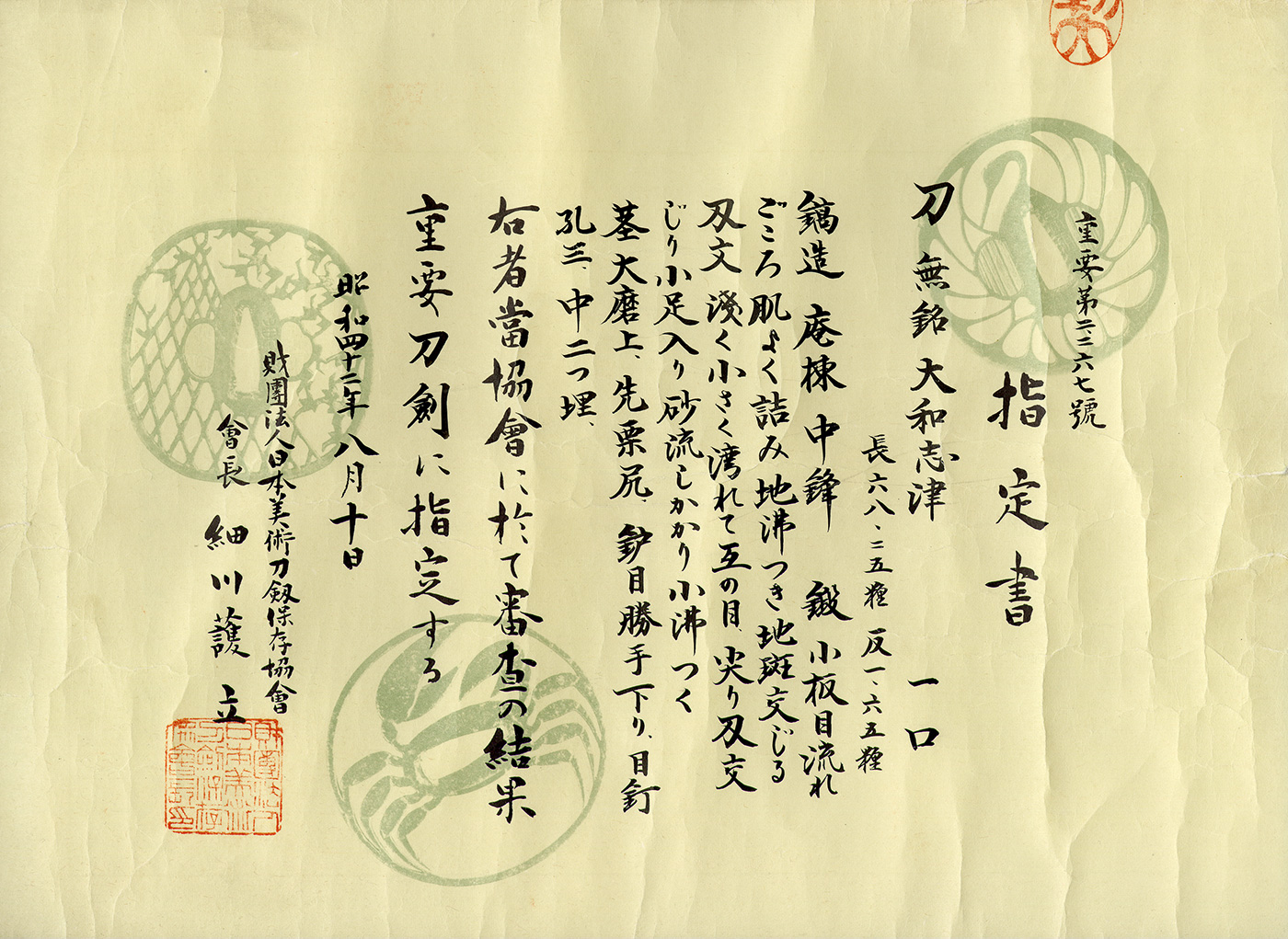
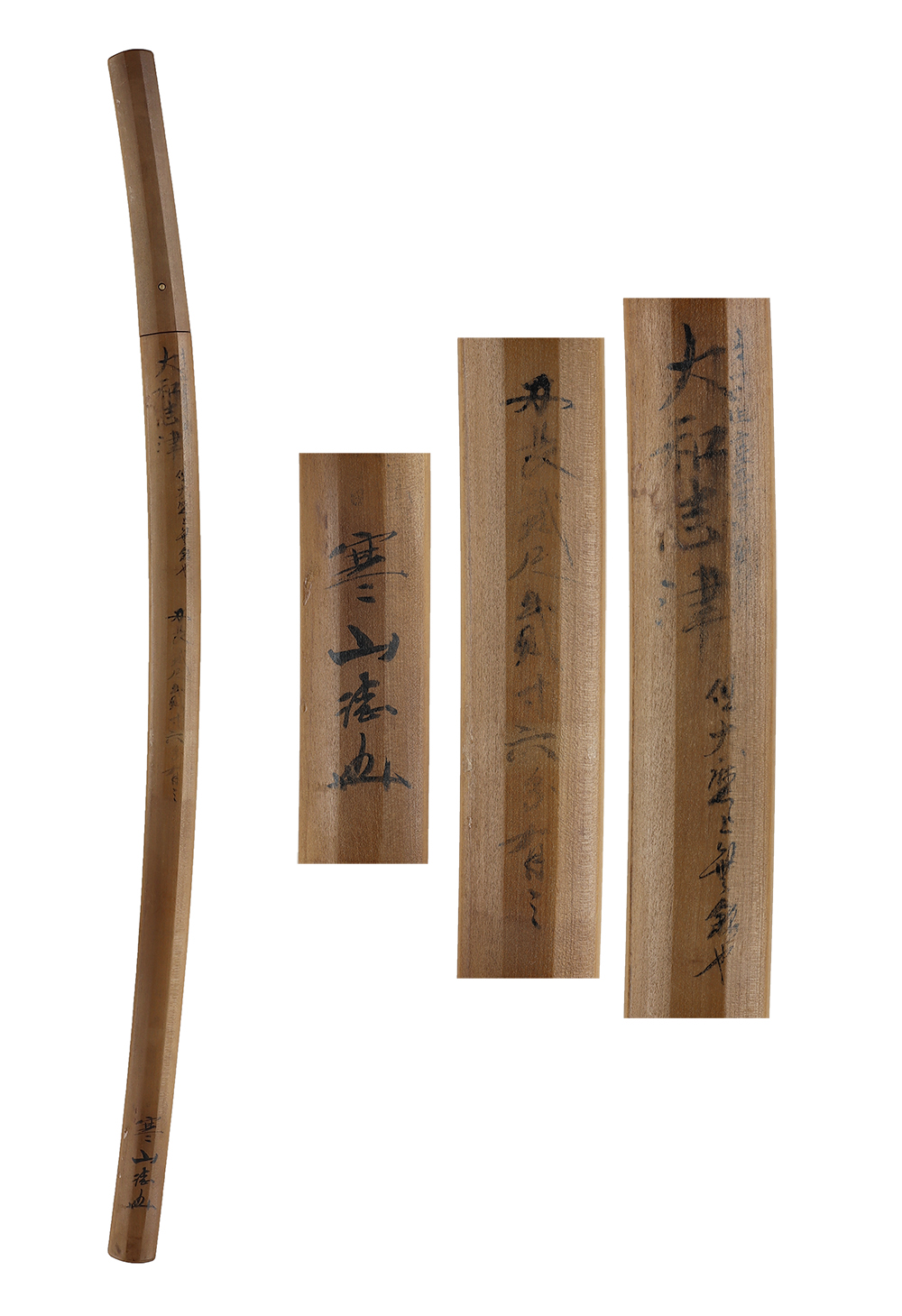
Katana in Shirasaya (16th NBTHK Juyo Token)
Signature: Mumei (Unsigned)(Yamato-Shizu)
無銘 (大和志津)
We classify swords into Saijyo Saku, Jyojyo Saku, Jyo Saku, and Regular Saku based on the swordsmith’s skill.
Among unsigned Yamato-Shizu works, this piece is ranked as Saijyo Saku.
Habaki: Gold-plated double habaki.
Blade Length: 68.0 cm (26.77 in)
Curvature: 1.8 cm (0.71 in)
Mekugi Hole: 3 (2 of them filled)
Width at Base (Motohaba): 2.74 cm (1.08 in)
Width at Tip (Sakihaba): 1.84 cm (0.72 in)
Thickness (Kasane): 0.52 cm (0.20 in)
Sword Weight: 575 g
Era: From around the late Nanbokucho period to the early Kamakura period.
Shape: A work with a substantial mihaba (blade width) and an equally substantial kasane (thickness).
Jigane: Exceptionally well-forged, forming a fine, delicate ko-itame hada.
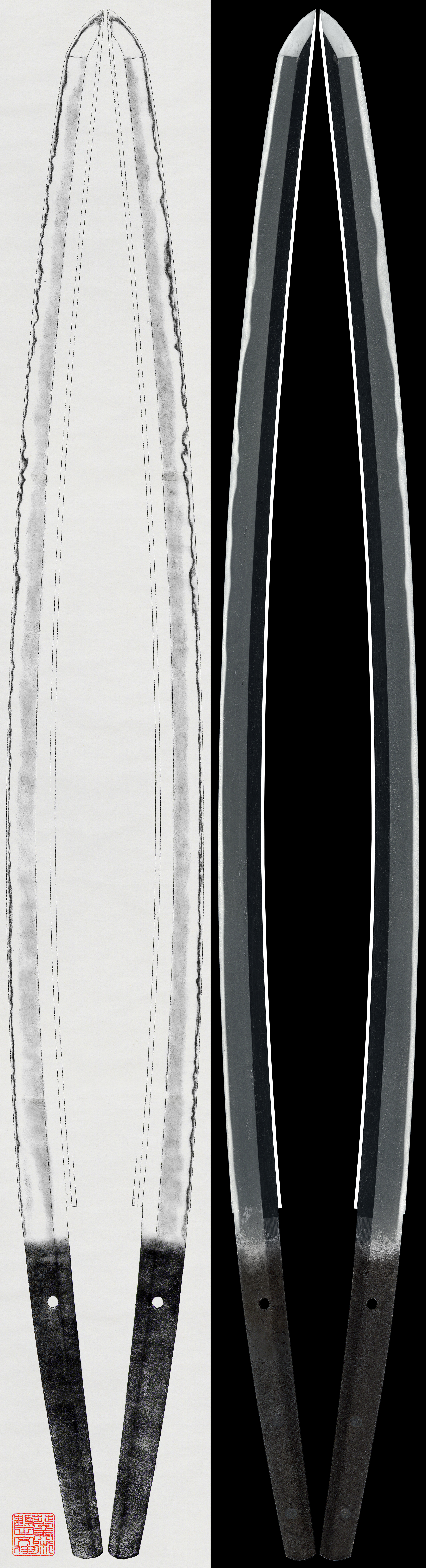
Hamon: A low gunome-midare; the boshi is in a yakitsume style.
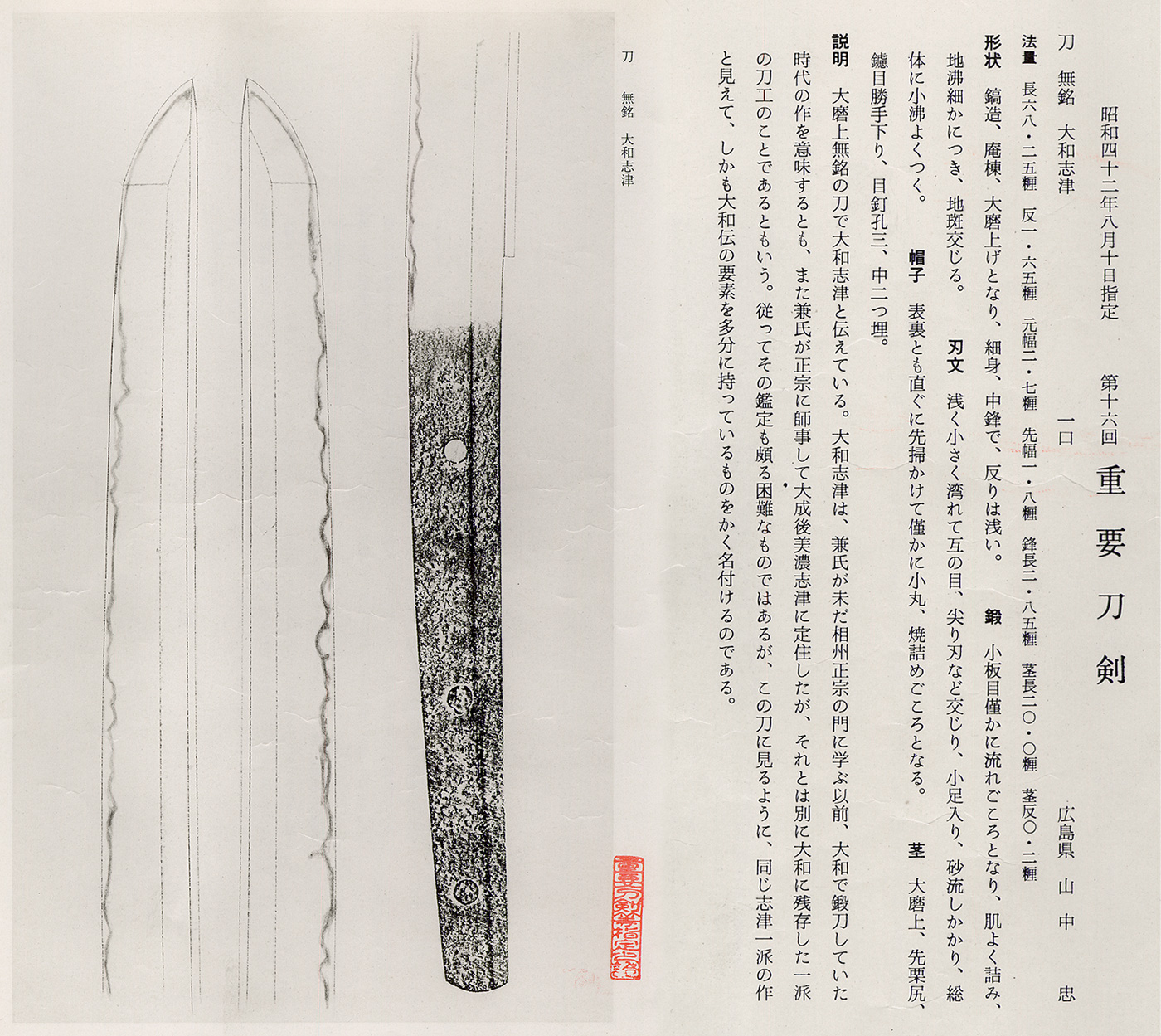
Features: This is an o-suriage (greatly shortened), unsigned katana attributed to Yamato-Shizu.
The term Yamato-Shizu is said to refer either to works made while Kaneuji was still forging swords in Yamato, before he studied under Masamune of Soshu, or to a separate group of smiths who remained in Yamato after Kaneuji had studied under Masamune, attained mastery, and settled in Mino as Mino-Shizu.
Its appraisal is therefore exceedingly difficult, but—as can be seen in this sword—the name is given to works that appear to be by the same Shizu school yet retain abundant elements of the Yamato tradition.
Its production dates from the late Kamakura to the early Nanbokucho period, and it fully displays the characteristics of the Yamato den.
Aoi Art’s Comment: A certain renowned sword appraiser once asked me which of the two is superior and which inferior, Yamato-Shizu or Naoe-Shizu.
He said that Yamato-Shizu is the more fitting.
Since then, I have observed them with care.
I believe Yamato-Shizu has the trait of an unexpectedly deep hamon, whereas Naoe-Shizu tends to show a broader hamon.
I feel that Yamato-Shizu captures the Yamato character especially well.
Looking at numerous Juyo Token, one comes to understand clearly why such blades are judged to be Yamato.
I consider Yamato-Shizu to be older in date than Naoe-Shizu, and I also regard its jigane as fine.
Historical Background: The late Kamakura period (the latter half of the 13th century to 1333) was a turbulent age marked by the economic distress of the gokenin (vassals) brought on by the successive Mongol invasions (Genko), and by the political corruption that advanced under the autocracy of the Hojo clan (the Tokuso despotism).
It refers to the period of upheaval during which discontented samurai and the imperial court rose in arms, culminating in the fall of the Kamakura shogunate in 1333.
16th NBTHK Juyo Token
Aoi Art estimation paper: Whole Oshigata
Please note: The price does not include the international shipping fees.



Auction Expired
Auction Expired because there were no bids
Auction has expired
Auction Expired because there were no bids|
Auction started
2026/06/16 (Tue) 14:03 |
※ = Auto