Description
Ordering Number: AS26196
Tanto in Shirasaya with Koshirae.(NBTHK Tokubetsu Hozon Paper)(Consignment Sale)
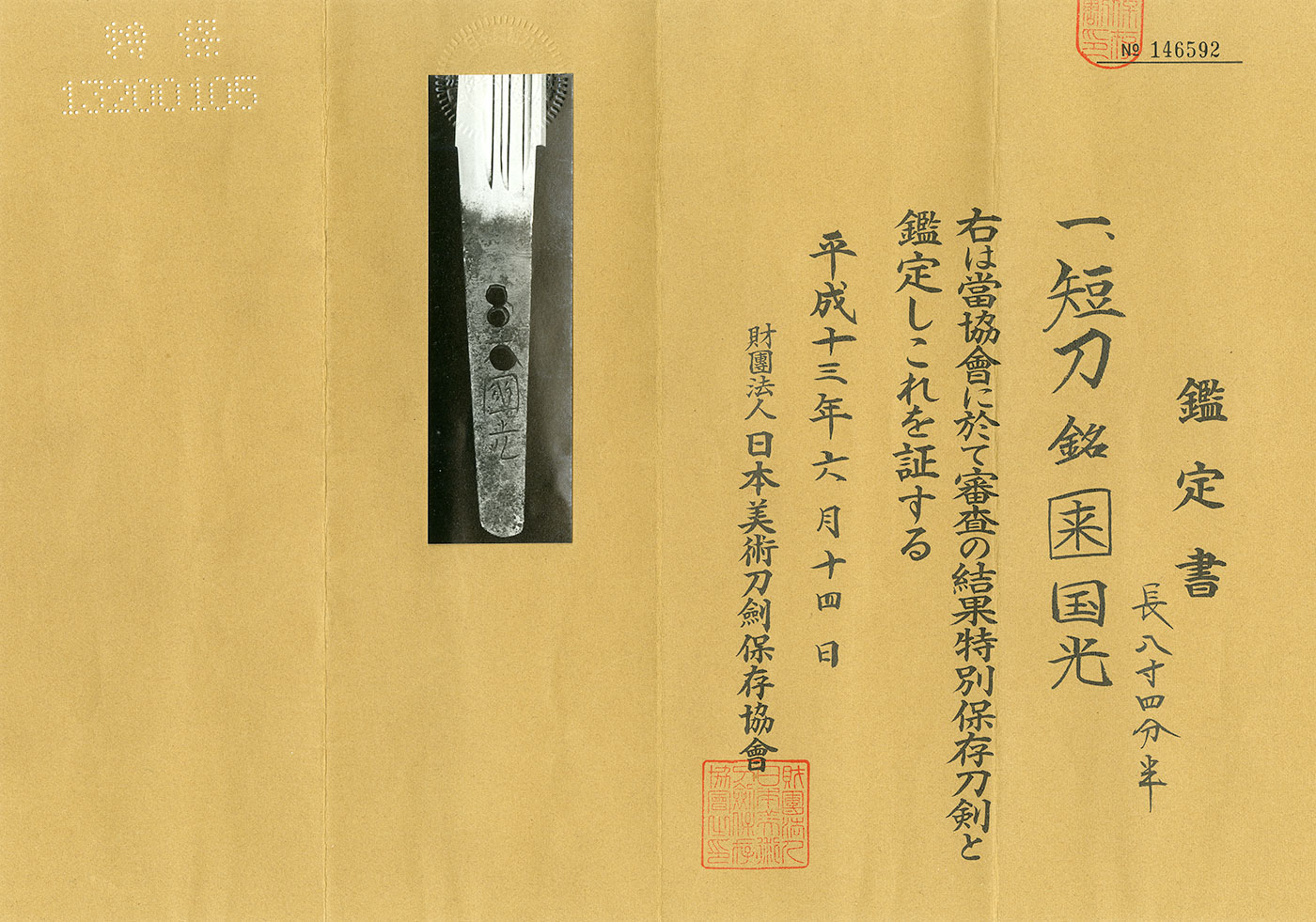
Signature : Rai Kunimitsu
来国光
(We divide 4 sections for each sword as Saijyo saku, Jyojyo saku Jyo saku and regular saku)
This sword belongs to yo Jyo saku Jyo Saku Regular saku J ranking.
Habaki : Gold failed J single habaki.
Blade length : 25.60 cm or 10.1 inches.
Sori : 0 cm or 0 inches.
Mekugi : 3
Width at the hamachi : 2.41 cm or 0.94 inches.
Kasane : 0.55 cm or 0.22 inches.
Era : Later Kamakura period.
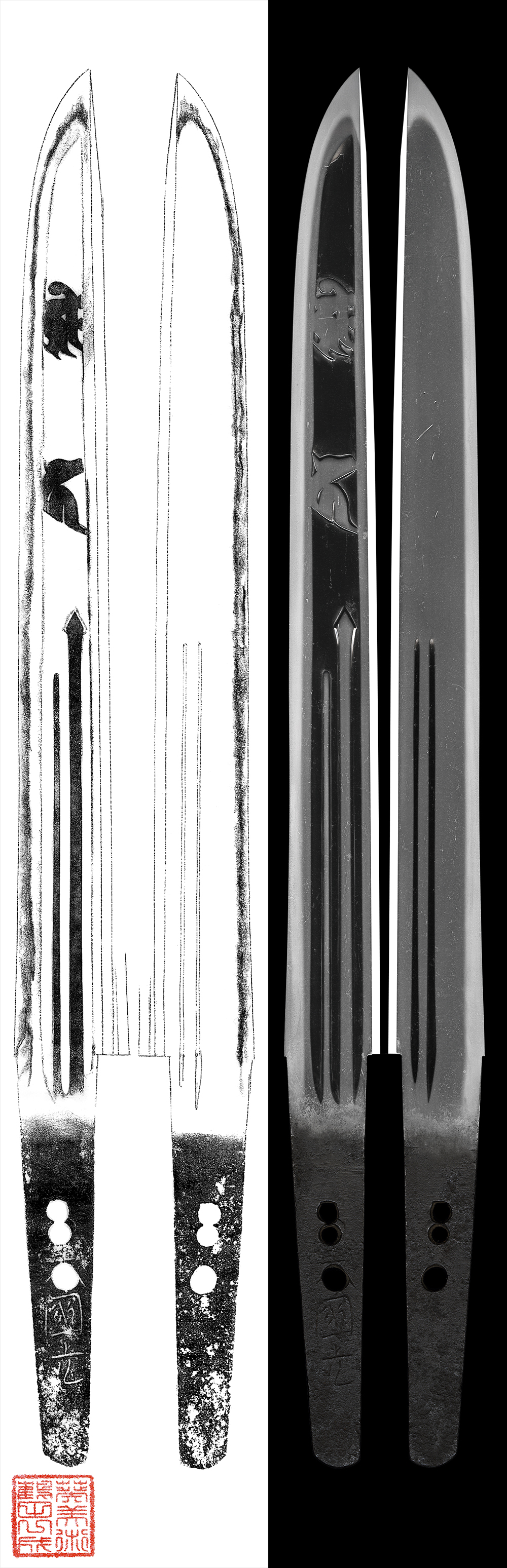
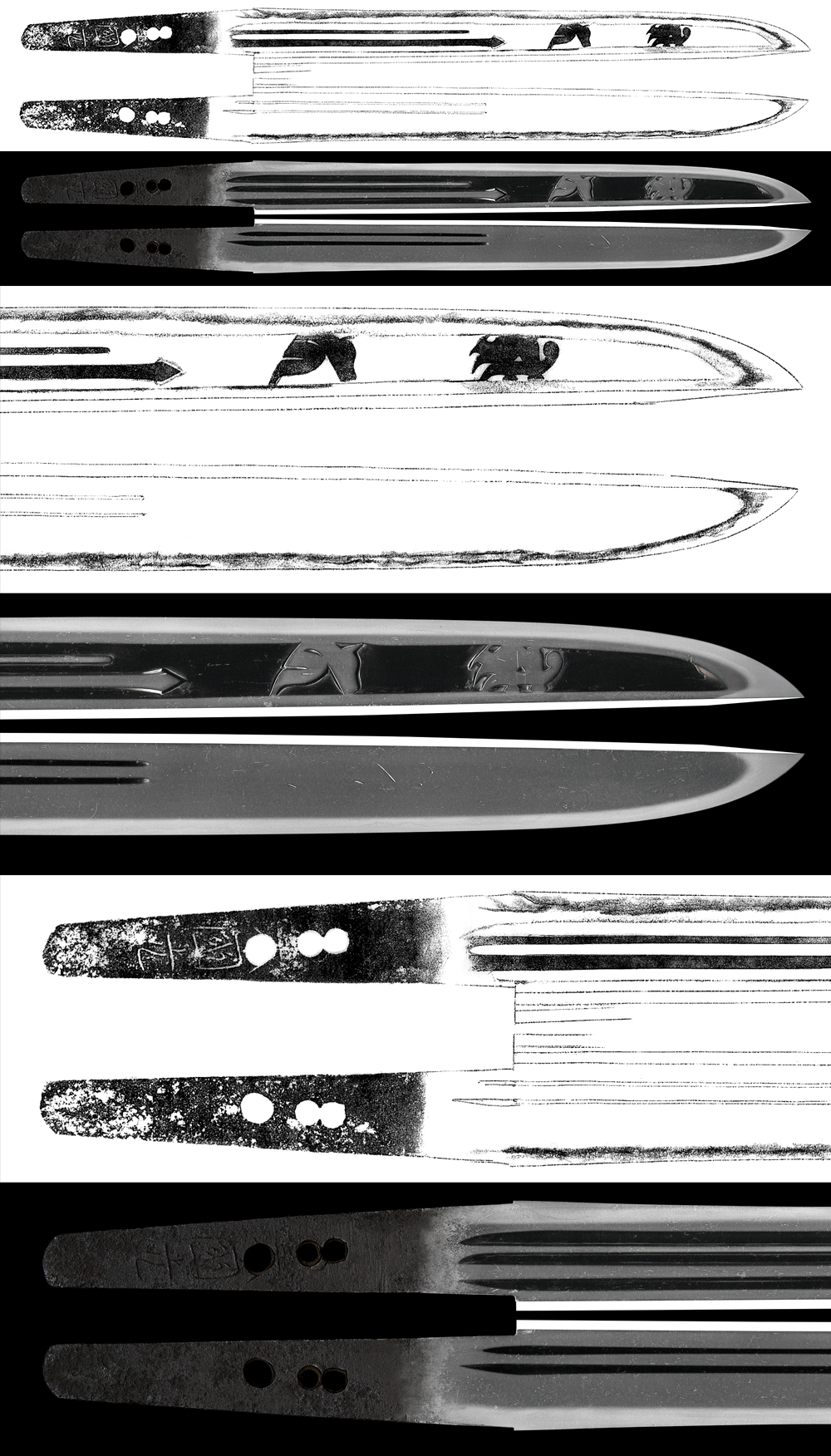
Shape: A well-proportioned tanto with slightly wide mihaba, thick kasane, and a mitsu-mune construction with uchizori curvature.
A wide bo-hi is carved on the blade, along with a suken and groove, and a bonji character is carved near the tip.
On the reverse side, gomabashi grooves are carved, and although partially worn away near the tip, a bonji character can also be seen.
Jigane: Fine ko-itame mixed with komokume hada is extremely well forged, with finely attached ji-nie and visible utsuri.
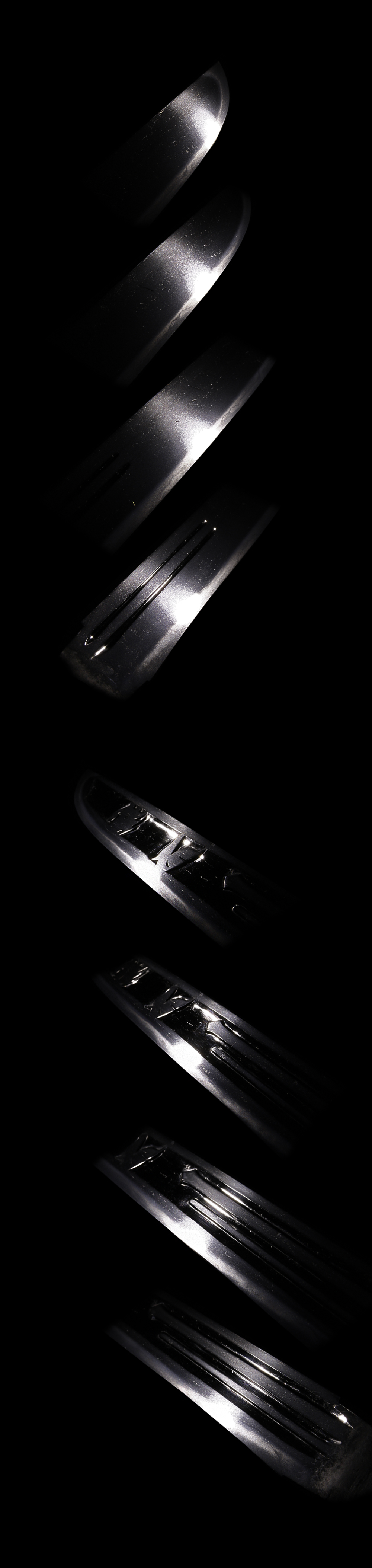
Hamon: Nie-deki suguha with a deep nioiguchi.
Within the hamon, sunagashi and kinsuji are actively present.
Particularly on the ura side, kinsuji work vigorously around the monouchi and boshi area.
Boshi: Turns back in a rounded manner, with fine kinsuji working within the boshi.
Features: According to traditional theory, Rai Kunimitsu was the son of Rai Kunitoshi and was active from the late Kamakura period into the Nanbokucho period.
Among his extant works, the earliest dated example is from Karyaku 1 (1326), and the latest is from Kanno 2 (1351).
In addition to traditional pure suguha, Kunimitsu produced a wide variety of styles, including suguha mixed with small gunome and ko-choji, suguha with slight irregularities, notare mixed with gunome, and gunome-midare.
Combined with the diversity in the shapes of his tachi and tanto, he is regarded as the most versatile smith within the Rai school.
The Kyoho Meibutsu records list five famous Rai Kunimitsu blades, including “Uraku Rai Kunimitsu,” “Goto Rai Kunimitsu,” “Ikeda Rai Kunimitsu,” “Niimi Rai Kunimitsu,” and “Shiokawa Rai Kunimitsu.”
In addition, “Watari Rai Kunimitsu” was formerly owned by Watari Hyogo no Kami Nyudo Ansai, a senior retainer of the Date family in Oshu, and was later presented to the Date clan.
Date Masamune reportedly wore it when attending Edo Castle, demonstrating that Rai Kunimitsu was already considered one of the most highly esteemed master smiths of the time.
Although this tanto is signed, its jigane, hamon, and powerful sugata fully embody the highlights of Rai Kunimitsu’s workmanship, making it an especially fine example among authenticated works.
The activities within the hamon on the ura side are particularly remarkable.
Rai Kunimitsu produced both suguha-based works with ashi and yo, as well as midareba works with a Soshu-style flavor such as seen in this piece.
Another characteristic is its somewhat more magnificent sugata compared to Kyoto Awataguchi and Sanjo works.
This is an exceptionally rare masterpiece.
Koshirae:
Tsuba: Kozuka-claw-shaped shakudo plain tsuba with susuki leaves in takabori and gold iro-e decoration.
Fuchikashira: Shakudo ground with chrysanthemum flowers in takabori and gold iro-e decoration.
Saya (Scabbard): Kaerazame saya using stingray skin with lacquer applied between the textured surfaces.
Menuki: One side depicts a figure carrying a basket, while the other side appears to depict a bee and spider fighting, rendered in takabori with gold iro-e decoration.
Kozuka: Shakudo nanako ground with a figure setting a trap to capture an animal, rendered in takabori with gold iro-e decoration.
This is a rare design.
Kogatana: Signed “Soshu ju Yoshihiro.”
Aoi Art’s Comment: The ken and bonji carvings on the omote side can also be seen on other tanto.
However, the carving combining bonji and ken together is rare.
In particular, the hamon on the ura side is magnificent, with exceptionally active kinsuji, making this an outstanding masterpiece.
NBTHK Tokubetsu Hozon Token Certificate.
Aoi Art estimation paper: Whole Oshigata.
Please note: the price does not include the shipping fees.


 日本語
日本語