Description
Order Number: AS09056
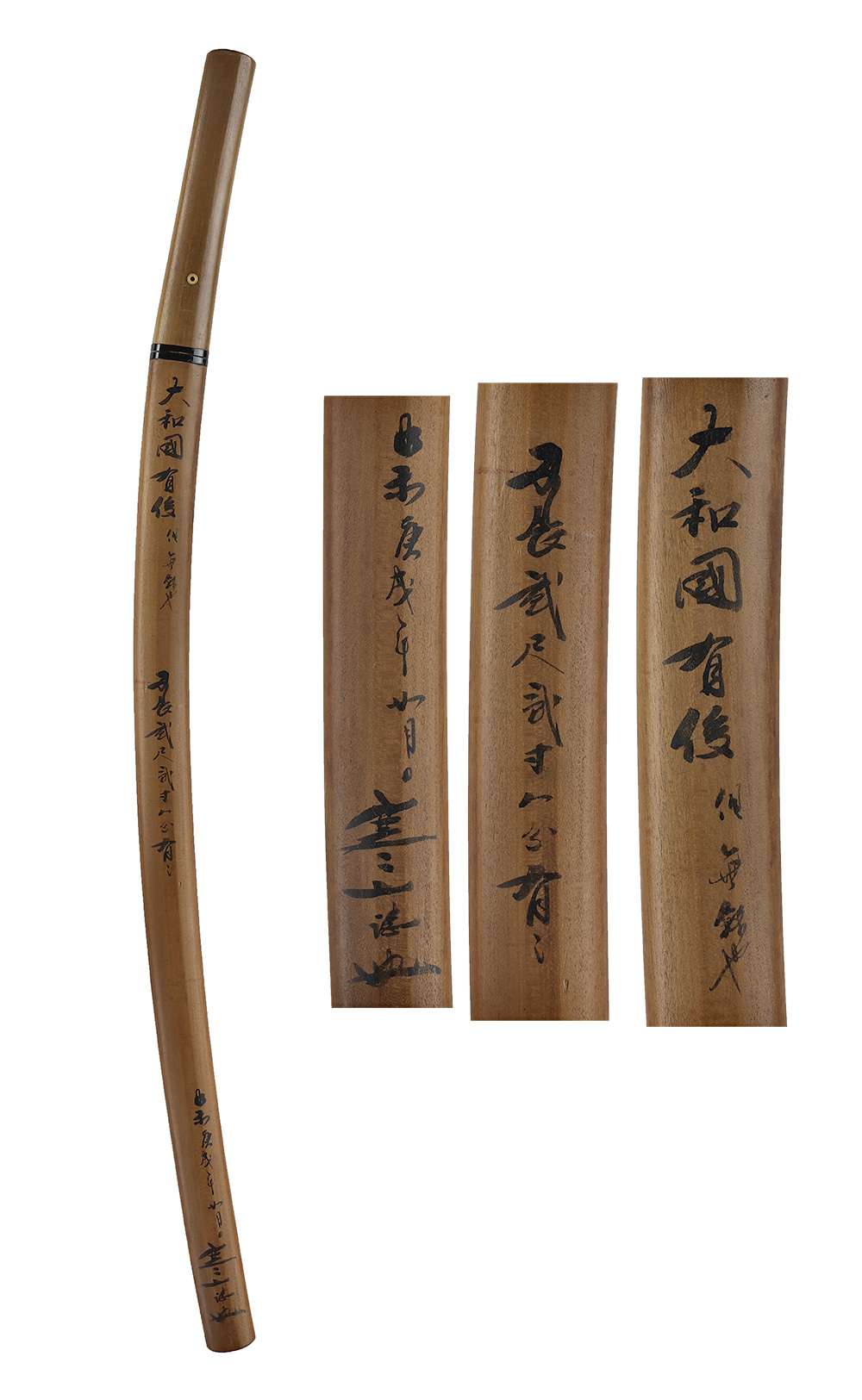
Katana: Shirasaya with Koshirae
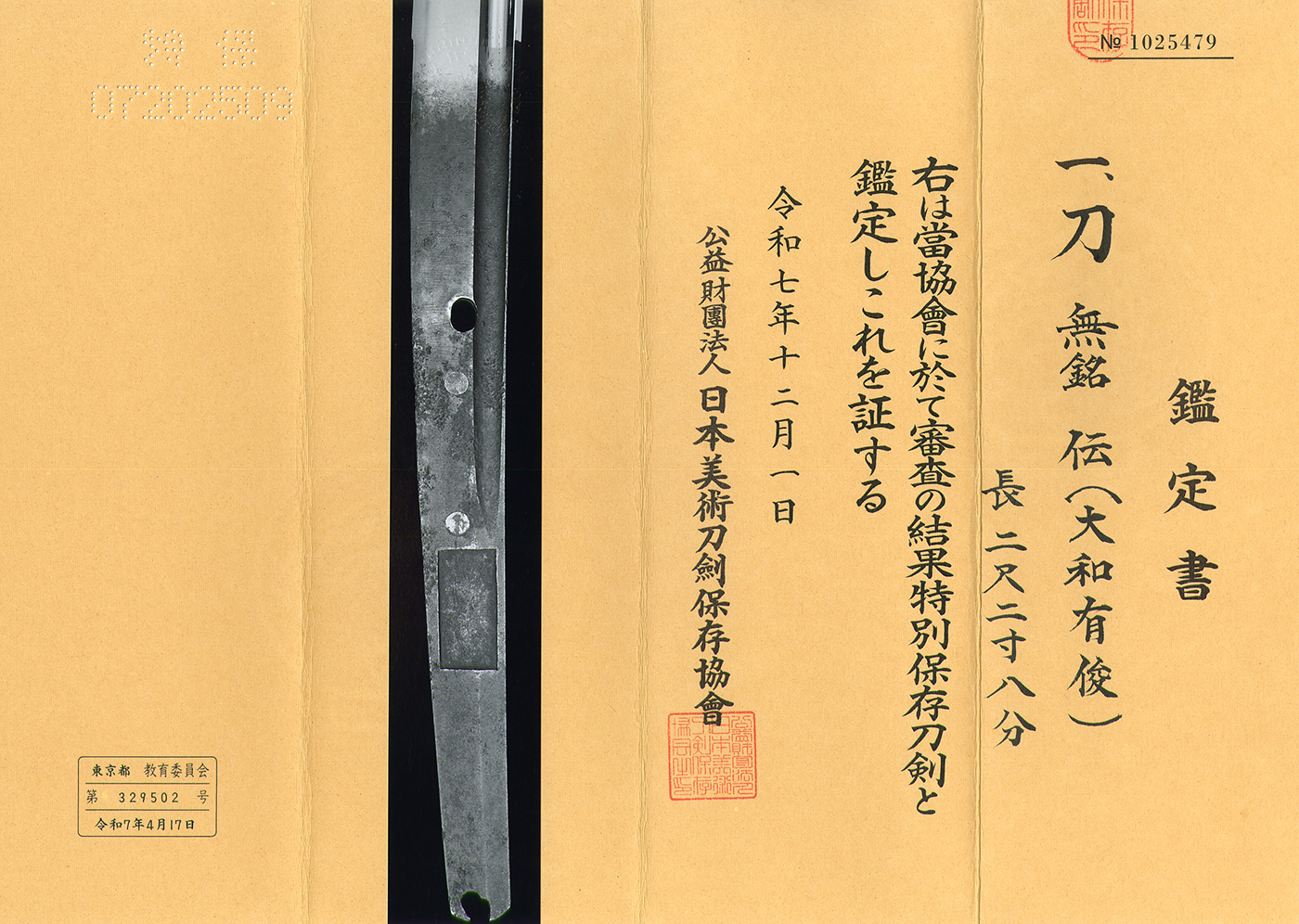
Signature: Mumei (attributed to Yamato Aritoshi) (NBTHK Tokubetsu Hozon Token / NTHK Tokubetsu Kicho Token)
Old Sword (Kotō): Jōjō-saku (Superior Work): Yamato Tradition
At Aoi Art, we classify swords according to the quality of workmanship as Saijō-saku (Supreme), Jōjō-saku (Superior), Jō-saku (Excellent), and Standard. This blade, attributed to Mumei Yamato Aritoshi, is ranked as Jōjō-saku (Superior Work).
Habaki: Double Habaki with Gold Foil Covering
Blade Length: 69.2 cm (27.24 in)
Curvature: 2.2 cm (0.87 in)
Mekugi-ana: 3 (2 plugged)
Motohaba: 2.88 cm (1.13 in)
Sakihaba: 1.87 cm (0.74 in)
Kasane: 0.65 cm (0.26 in)
Blade Weight: 585 g
Period: Kotō, around the Jōji era of the Nanbokuchō period (1362–1368)
Shape:
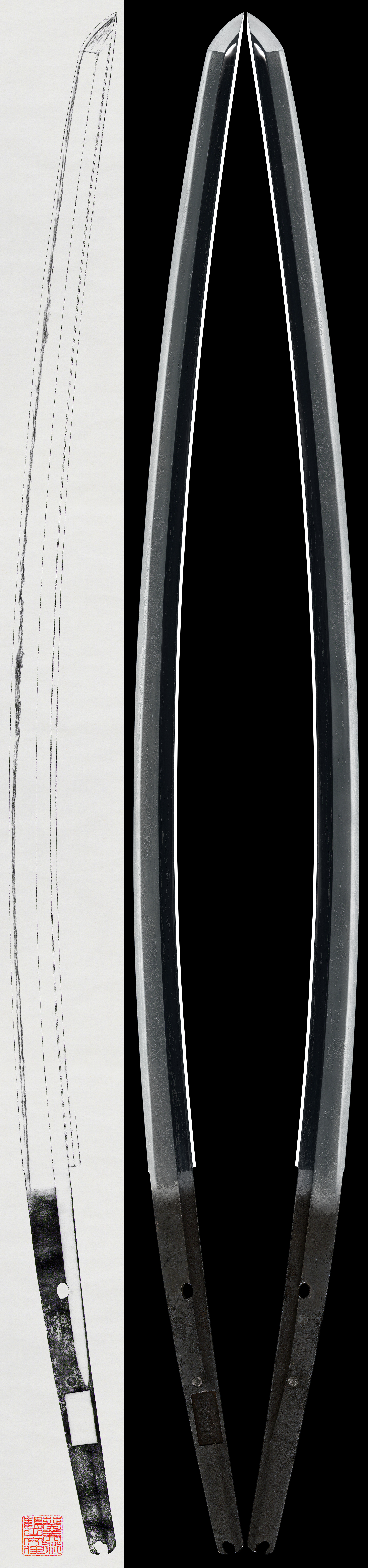
The blade has an average width with a bōhi groove. It displays a deep curvature, and the kissaki is of standard proportion.
Jigane:
The steel shows a well-forged itame-hada grain with a distinct utsuri appearing in the ji.
Hamon:
A hamon close to suguha, featuring prominent nijūba (double temper line) with fine ko-ashi. The boshi is in hakikake style and finishes in an almost yakitsume boshi.
Features:
This sword was designated as Mumei (Yamato Chō-Aritoshi) on its Tokubetsu Kichō appraisal and attributed to Aritoshi of the Yamato Taima School. Aritoshi is said to have borne the title Chōbei-no-jō and also forged swords in Toba, Yamashiro Province. “Chō-Aritoshi” is generally considered to be an abbreviated form of Chōbei-no-jō Aritoshi.
This blade exhibits the characteristic workmanship of the Yamato Taima School, including long nijūba with ko-ashi appearing within the temper line and an almost yakitsume boshi. According to Fujishiro’s reference on Japanese swordsmiths, Aritoshi is highly ranked as Jōjō-saku (Superior Work), and this sword is an excellent example of his distinctive style.
Koshirae:
Tsuba:
Made of plain copper with shakudō decoration, depicting a small boat moored along a riverbank beside a rustic thatched hut, while birds fly in the distant landscape.
Fuchi-Kashira:
Plain copper fittings. The kashira is decorated with a dragon, while the fuchi depicts a tiger.
Saya:
A decorative lacquered scabbard finished in an unusual style, adorned with a family crest in gold.
Menuki:
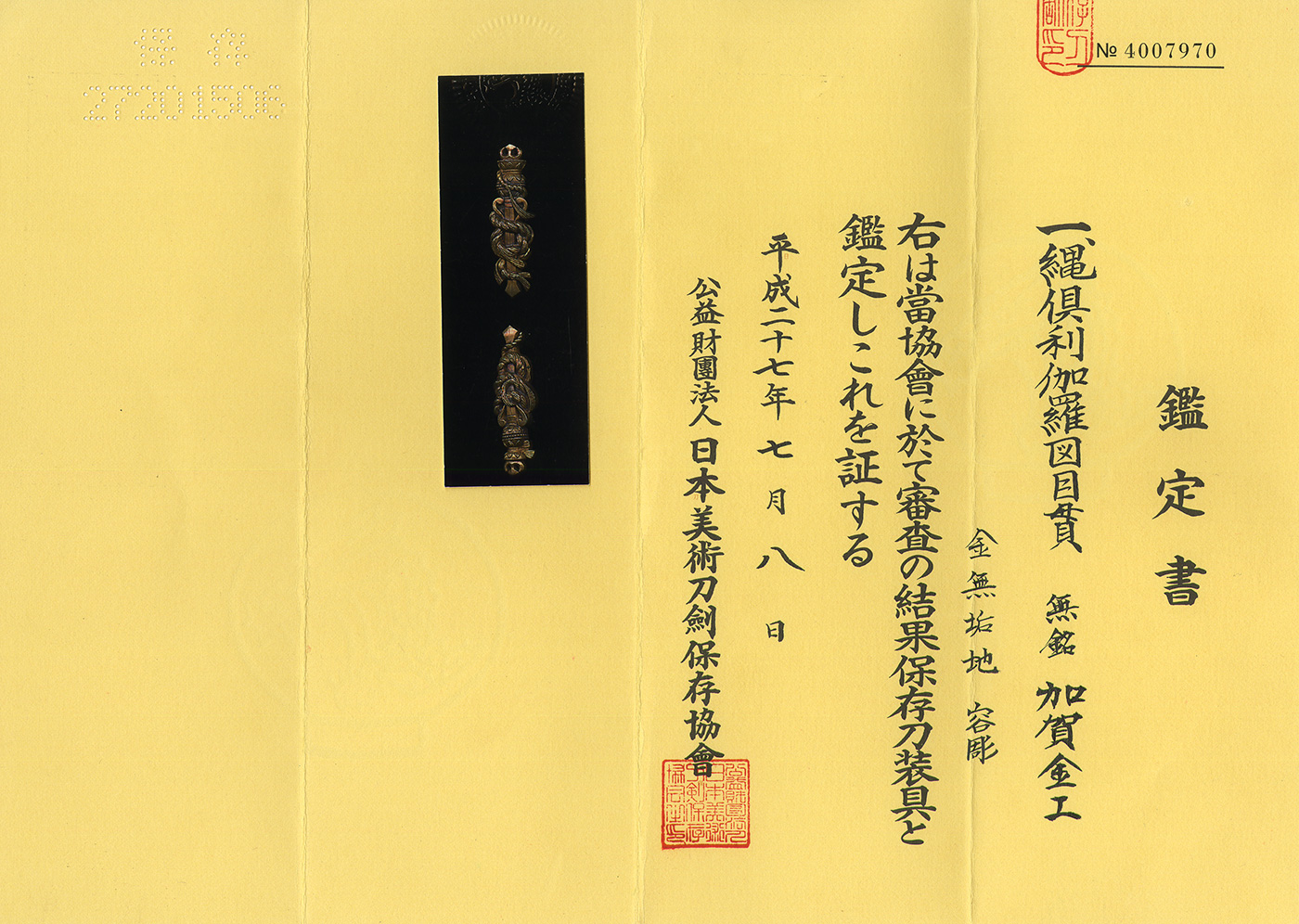
Finely crafted gilt dokko (Buddhist ritual vajra) ornaments.
Seppa:
Two copper seppa covered with 18-karat gold.
Historical Background:
The Jōji era (1362–1368) of the Northern Court during the Nanbokuchō period was a time of significant political upheaval within the Muromachi Shogunate. Internal conflicts, including the aftermath of the Kannō Disturbance, reshaped the balance of power, eventually leading to the succession of Ashikaga Yoshimitsu as shogun. It was an era in which the military government underwent major political changes, and swords forged during this period are highly valued for their historical significance as well as their outstanding craftsmanship.
Please note: the price does not include the shipping fees.


 日本語
日本語