
 日本語
日本語Bid History
Auction has expired
Auction Expired because there were no bids|
Auction started
2026/04/08 (Wed) 13:41 |
※ = Auto
Katana in Shirasaya with Koshirae (Tokubetsu Hozon Token) (NBTHK Kicho Token)
Signature:
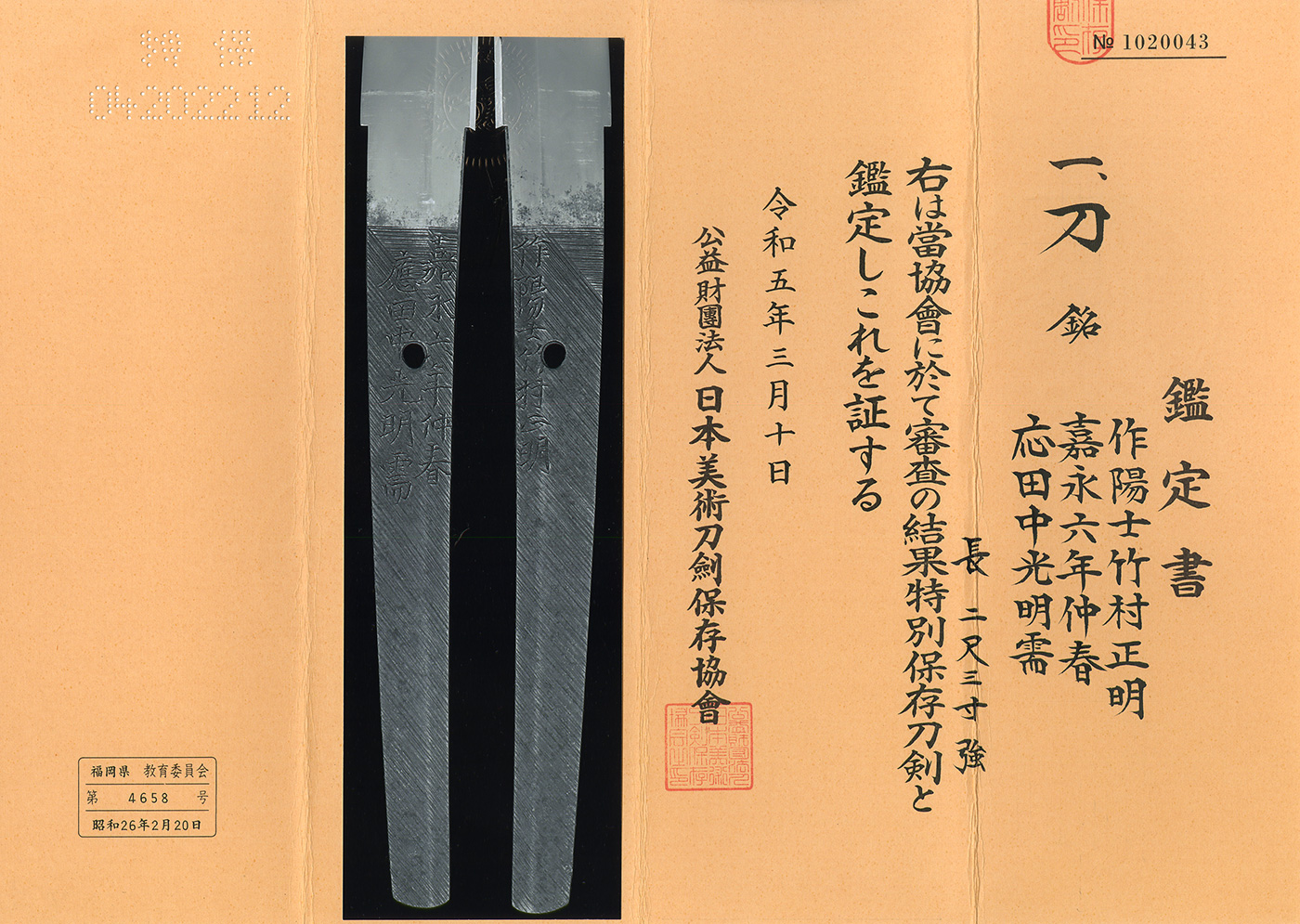
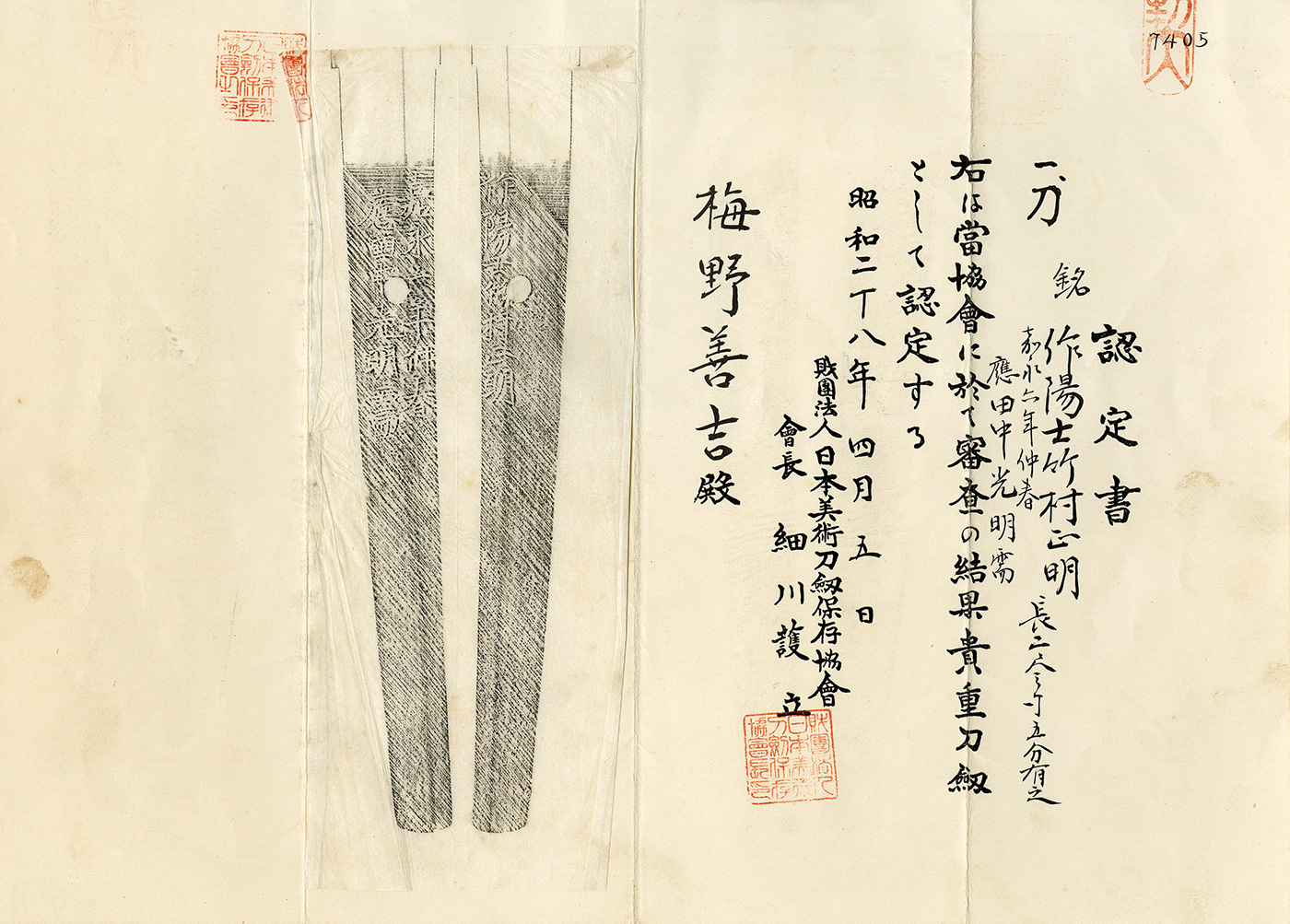
Sakuyōshi Takemura Masaaki 作陽士竹村正明(=Jōkeishi Masaaki 城慶子正明)
Kaei 6 Nen Chushun 嘉永六年仲春 (Mid-Spring,1853)
Made upon request by Tanaka Mitsuaki 応田中光明需
We divide 4 sections for each sword as Saijyo Saku, Jyojyo Saku, Jyo Saku and Regular Saku.
This work is ranked as Saijyo Saku (Highest Grade) among the works of Takemura Masaaki.
Habaki: Gold foil single Habaki
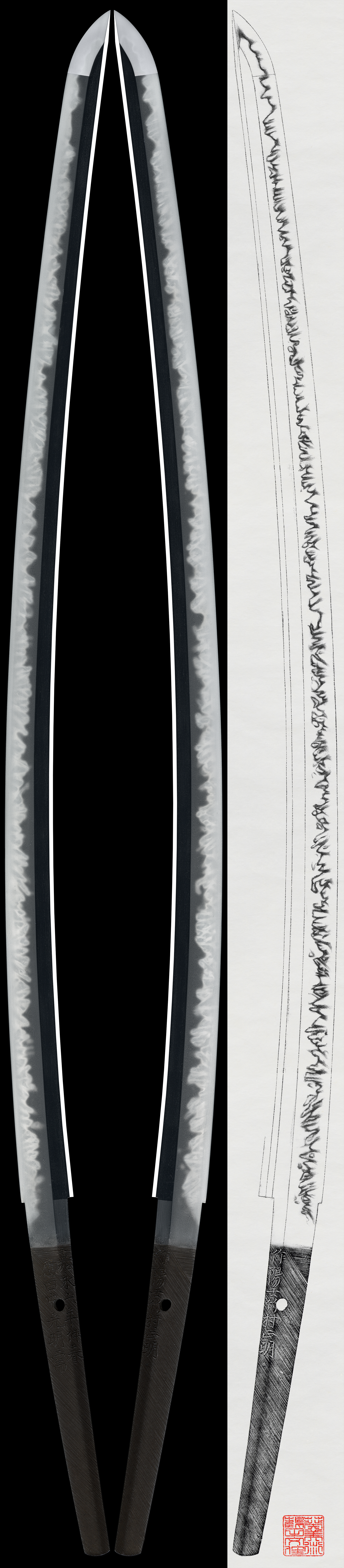
Blade Length: 2 shaku 3 sun – 69.7 cm (27.44 in)
Curvature: 6 bu 5 rin – approx. 1.97 cm (0.78 in)
Mekugi Hole: 1
Width at Base (Motohaba): 3.09 cm (1.22 in)
Width at Yokote (Sakihaba): 2.08 cm (0.82 in)
Thickness of rim (Kasane): 0.68 cm (0.27 in)
Sword Weight: 750 g
Era: late Edo period, around Kaei era (1853)
Shape: wid and deeply carved long blade
Jigane: Fine Koitame hada looking plane jigane
Hamon: Choji and Sakasa Choji with thick and soft Nioikuchi.
Features:
Masamasa was a swordsmith from Tsuyama in Okayama Province. He later went to Edo, where he studied under Hosokawa Masayoshi. Afterwards, he worked in Fukagawa, Edo, as a domain swordsmith for the Echizen Matsudaira clan of Tsuyama.
At the time, many swordsmiths followed the revivalist sword theory advocated by Suishinshi Masahide—which regarded old swords as the ideal—and produced blades with a pronounced curvature like this piece.
Among them, Masayoshi, like his master Masayoshi, forged flamboyant Ichimonji-like choji-midare temper patterns. He also shares similarities with Masayoshi in signatures such as “Sakuyō-shi (Shi basically means Samurai)” and in the file marks strongly carved on the tang.
This work can be regarded as one of the smith’s finest achievements, featuring a superb choji-midare temper pattern. It is likely that its exceptional quality is largely due to it having been a special-order piece. The identity of the patron, Tanaka Mitsuaki, remains unknown.
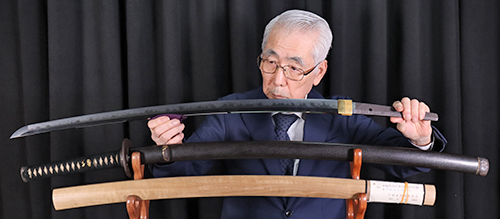
Koshirae:
Tsuba: round iron tusba carved with water flaws and maple leaves.
Kurigata: iron base, carved with bamboo leaves.
Fuchikashira: iron base carved with bamboo leaves and a crescent moon.
Kojiri: Iron base with a maple leaf motif.
Menuki: a design of Shishi-dog.
NBTHK Tokubetsu Hozon Token Certificate
NBTHK Kicho Token Certificate
Aoi Art estimation paper: Whole Oshigata



Auction Expired
Auction Expired because there were no bids
Auction has expired
Auction Expired because there were no bids|
Auction started
2026/04/08 (Wed) 13:41 |
※ = Auto