
 日本語
Bid History
|
yogi.sanada
2026/10/25 (Sun) 00:04 |
¥650,000 |
|
Auction started
2026/10/24 (Sat) 11:31 |
|
※ = Auto
Ordering Number: AS26253
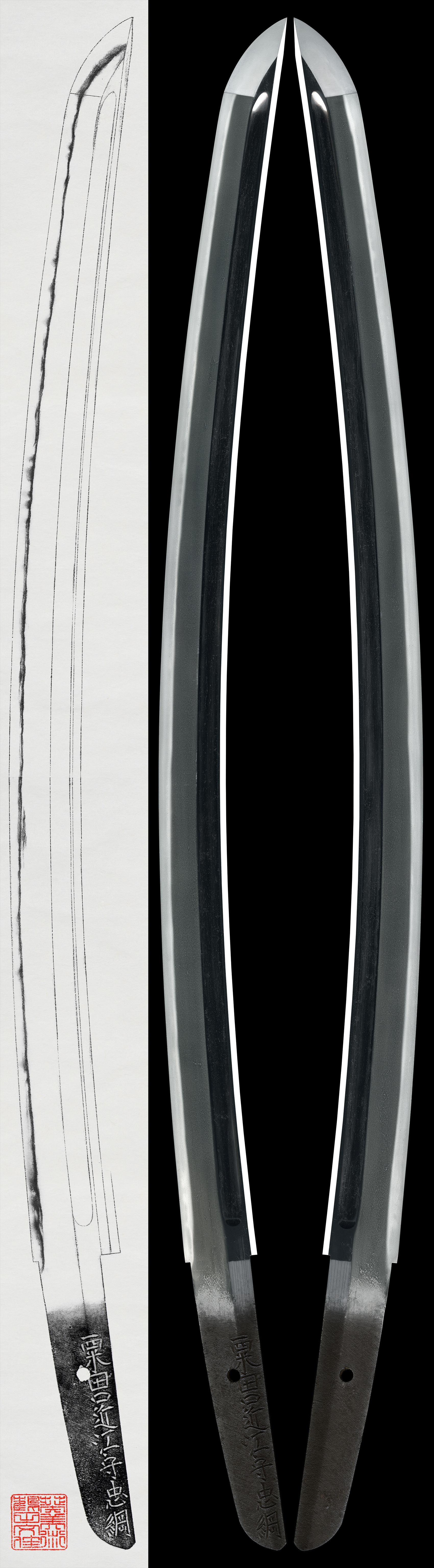
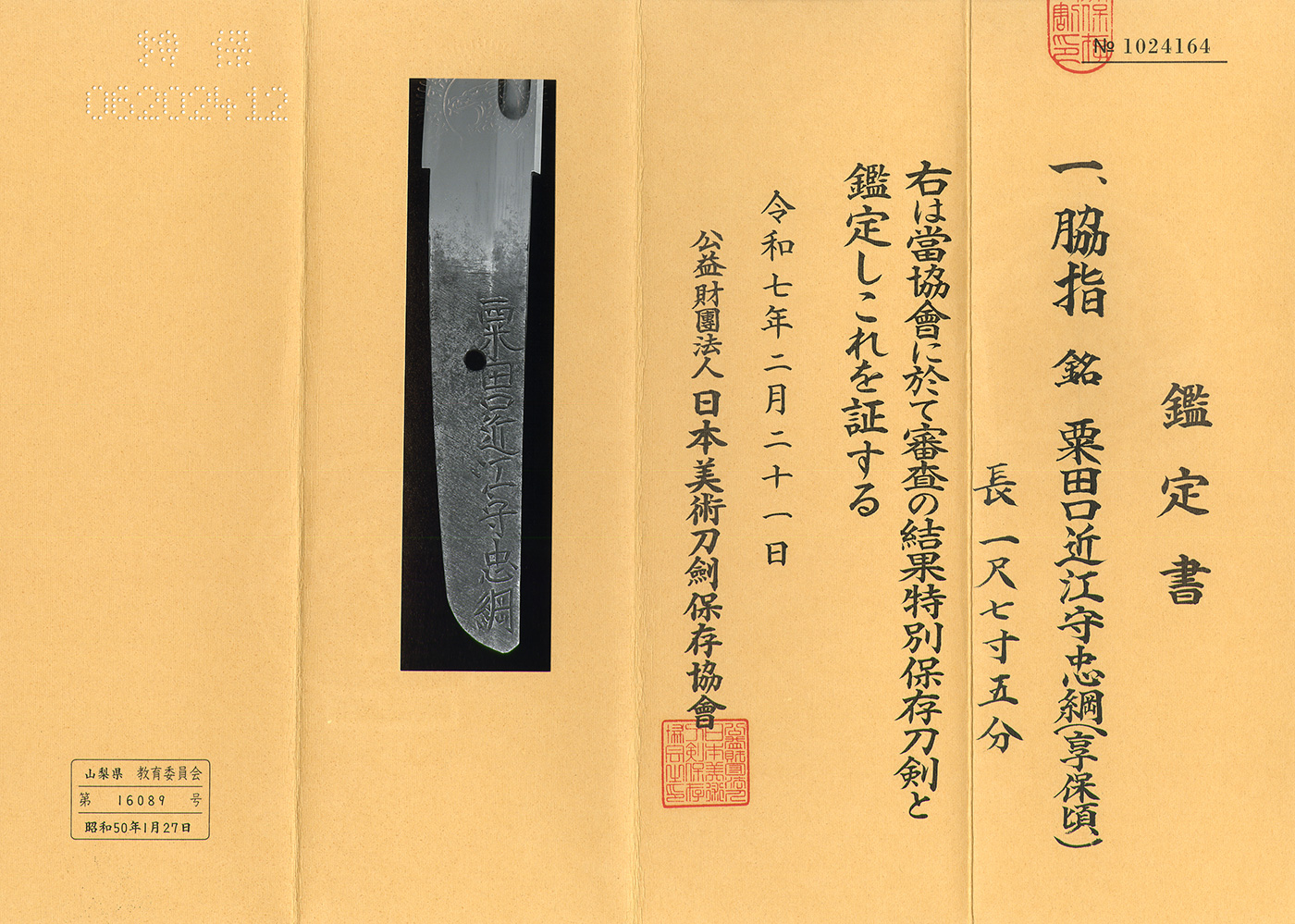
Wakizashi in Shirasaya (NBTHK Tokubetsu Hozon Token)
Signature: Awataguchi Omi no Kami Tadatsuna
粟田口近江守忠綱
Shinto: Naga Wazamono: Jyojyo Saku: Settsu Province
(We divide 4 sections for each sword as Saijyo Saku, Jyojyo Saku, Jyo Saku and Regular Saku).
This blade is ranked as Jyojyo Saku among the works of Awataguchi Omi no Kami Tadatsuna.
Habaki: Gold iroe habaki.
Blade Length: 53.0 cm (20.87 in).
Curvature: 2.0 cm (0.79 in).
Mekugi Hole: 1.
Width at Base (Motohaba): 3.06 cm (1.20 in).
Width at Yokote: 2.21 cm (0.87 in).
Thickness of rim (Kasane): 0.65 cm (0.26 in).
Sword Weight: 540 g.
Era: Around the Genroku era (1688–1704), Edo period.
Shape: A well-proportioned wakizashi with substantial kasane, a wide mihaba, deep curvature, and a slightly elongated kissaki.
Bo-hi are carved on both sides of the blade.
Jigane: Exceptionally tightly forged jigane displaying a masame-like grain pattern.
Hamon: Suguha with fine ko-ashi.
The boshi has a rounded tip and turns back.
Features: Awataguchi Tadatsuna was a swordsmith active in Osaka during the middle Edo period and belonged to a lineage associated with the prestigious Awataguchi school of Kyoto.
The 2nd-generation Tadatsuna, in particular, became widely known through an incident during the Tenmei era and is regarded as one of the representative Osaka swordsmiths of the 18th century.
Awataguchi Omi no Kami Tadatsuna was also known by the art name Ikkanshi and was highly regarded for his exceptional skill in horimono (decorative blade carvings).
The family claimed descent from Awataguchi Kunitsuna of Kyoto, a renowned swordsmith of the Kamakura period.
His father, the 1st-generation Tadatsuna, moved to Osaka and received the honorary title of Omi no Kami.
The 2nd-generation Tadatsuna is especially famous because of an incident that occurred on March 24, 1784 (Tenmei 4).
On that day, Sano Zenzaemon attacked and killed Tanuma Okitomo, a junior councillor (Wakadoshiyori) and the son of the senior councillor Tanuma Okitsugu, inside Edo Castle.
It is said that the large wakizashi used in the assassination was forged by the 2nd-generation Tadatsuna.
At the time, Tanuma Okitsugu was widely criticized for his allegedly corrupt administration, and Sano was celebrated by some as Yonaoshi Daimyojin, meaning a divine figure who would reform society.
Following this incident, swords made by the 2nd-generation Tadatsuna gained sudden popularity as symbols of justice and became highly sought after.
Historical Background: The Genroku era (1688–1704) took place during the Edo period under the rule of the 5th Tokugawa Shogun, Tokugawa Tsunayoshi.
It was one of the most dynamic periods in Edo history, characterized by the flourishing of a distinctive and vibrant merchant culture alongside significant social and economic changes.
Literature and Ukiyo-zoshi: Ihara Saikaku wrote works such as Seken Munesan’yo (The Japanese Family Storehouse), vividly portraying the everyday lives and experiences of ordinary people.
Haikai Poetry: Matsuo Basho embarked on the journey that inspired Oku no Hosomichi (The Narrow Road to the Deep North), further developing the aesthetic ideals of wabi and sabi.
Bunraku and Kabuki: Chikamatsu Monzaemon wrote masterpieces such as Sonezaki Shinju (The Love Suicides at Sonezaki), contributing to the extraordinary popularity of puppet theater and kabuki.
Art and Ukiyo-e: Hishikawa Moronobu created the celebrated painting Mikaeri Bijin-zu (Beauty Looking Back) and became recognized as one of the founders of ukiyo-e.
The magnificent and decorative Rinpa school of painting, represented by artists such as Ogata Korin, also flourished during this period.
The Genroku Ako Incident (1702): This famous historical event became the inspiration for the story of Chushingura (The Treasury of Loyal Retainers).
The 47 ronin of Ako attacked the residence of Kira Kozuke no Suke to avenge their deceased lord, causing a sensation throughout Edo.
Currency Reform (Beginning in 1695): To address the financial difficulties of the Tokugawa shogunate, officials including Ogiwara Shigehide introduced new gold and silver coins with reduced precious-metal content, known as Genroku gold and silver coinage.
Although the reforms temporarily increased government revenue, they also contributed to rising prices and inflation.
Natural Disasters and the End of the Genroku Era
Toward the end of the Genroku era, Japan experienced devastating natural disasters that seemed to signal the conclusion of an extraordinary period.
The Genroku Earthquake (1703): A massive earthquake, estimated to have been approximately magnitude 8, struck the Kanto region.
Odawara Castle suffered severe damage, while powerful tsunamis devastated coastal communities around Edo and Sagami Bay.
Prelude to the Great Hoei Eruption: Following the earthquake and other developments, the era name was changed from Genroku to Hoei in 1704.
Only a few years later, in 1707, Mount Fuji experienced the catastrophic Hoei eruption.
The Genroku era can therefore be described as both a golden age of Japanese culture and a turbulent period marked by political contradictions, economic challenges, and devastating natural disasters.
NBTHK Tokubetsu Hozon Token Certificate.
AoiArt estimation paper.
Whole Oshigata.
Overseas shipping is charged separately.
Please note: The price does not include the international shipping fees.




Current bid: ¥650,000
|
yogi.sanada
2026/10/25 (Sun) 00:04 |
¥650,000 |
|
Auction started
2026/10/24 (Sat) 11:31 |
|
※ = Auto