
 日本語
日本語Bid History
|
Auction started
2026/06/17 (Wed) 11:01 |
※ = Auto
Ordering Number: AS26208
Tanto in Shirasaya, with Koshirae (NBTHK Tokubetsu Hozon Token) ((NBTHK Tokubetsu Kicho Token))
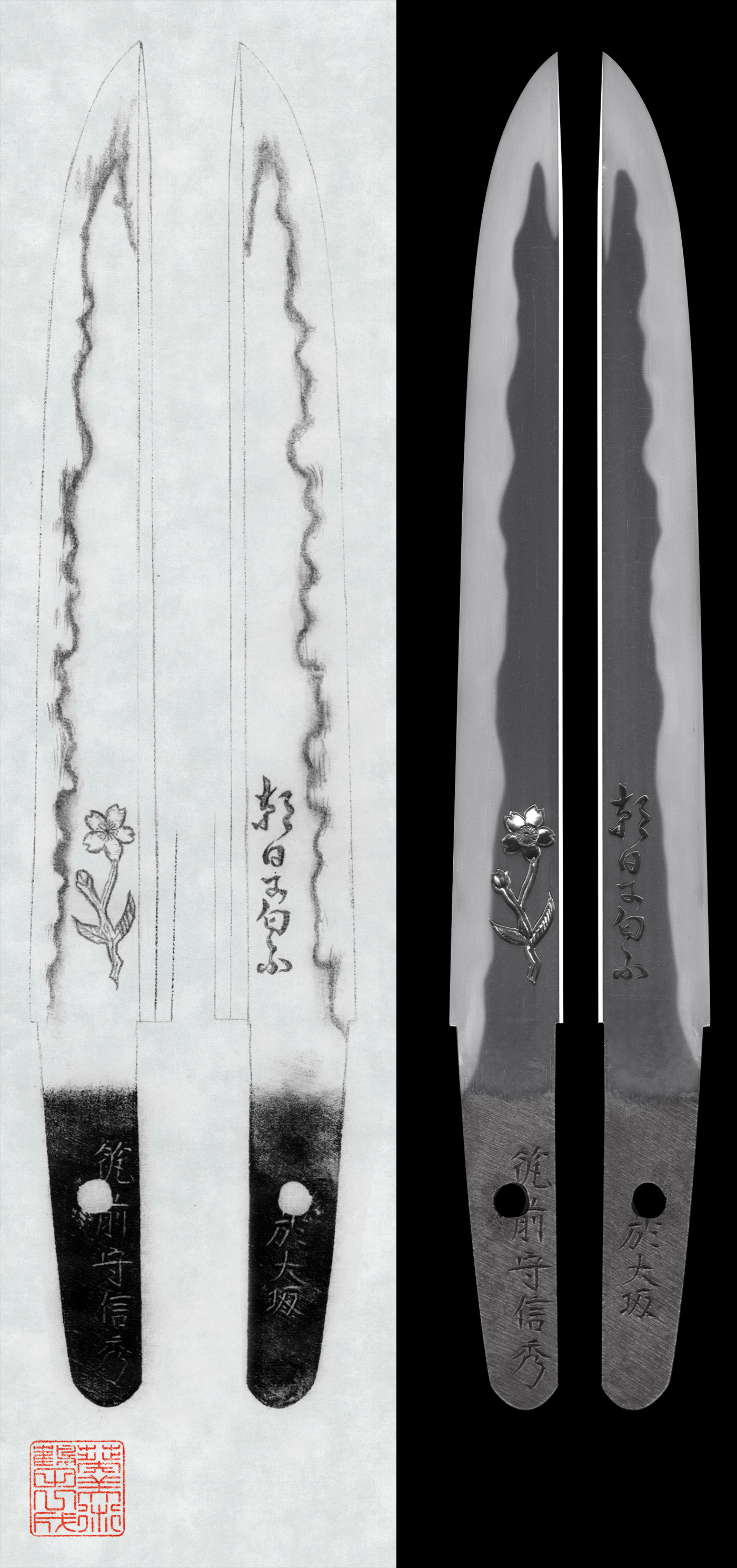
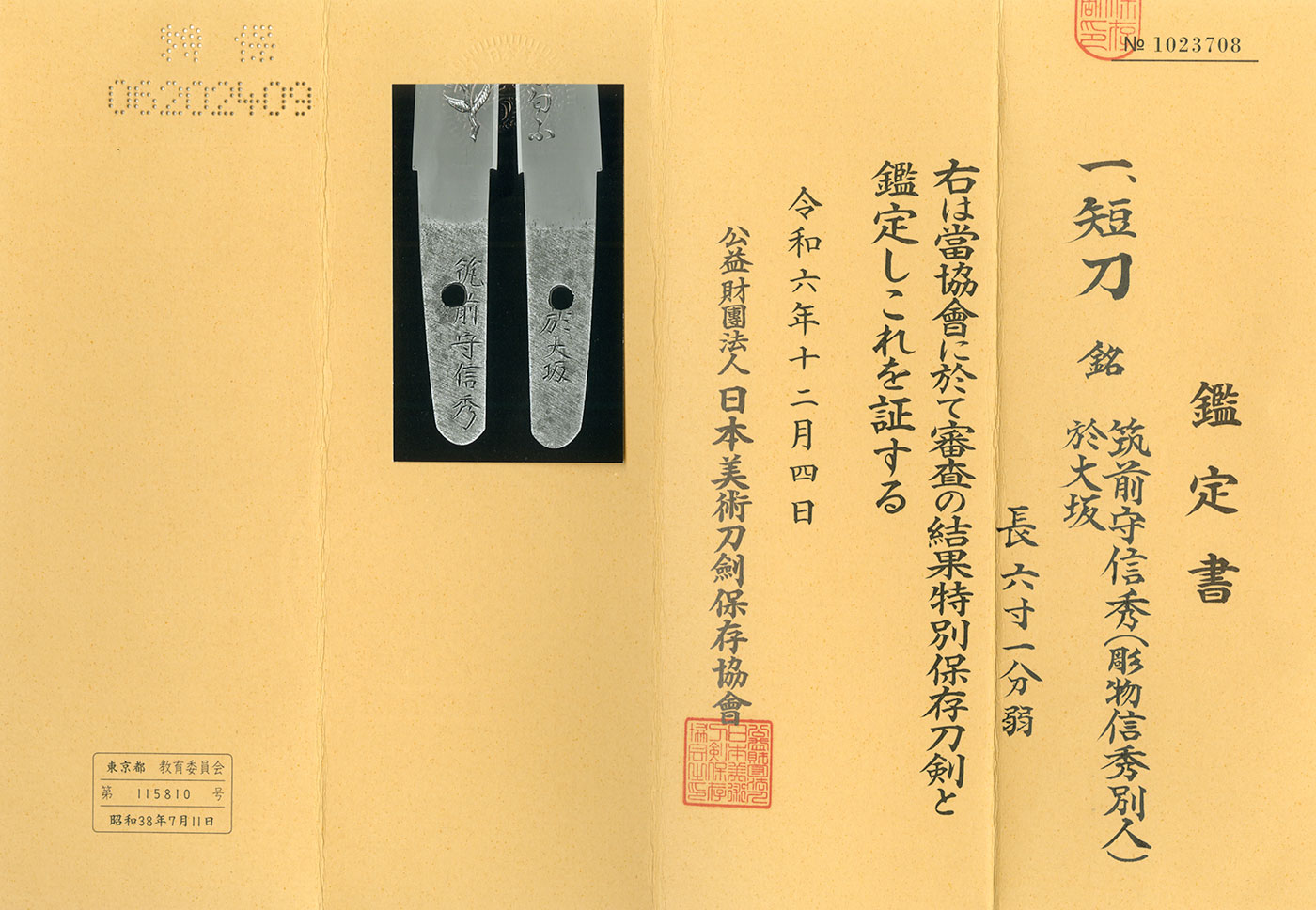
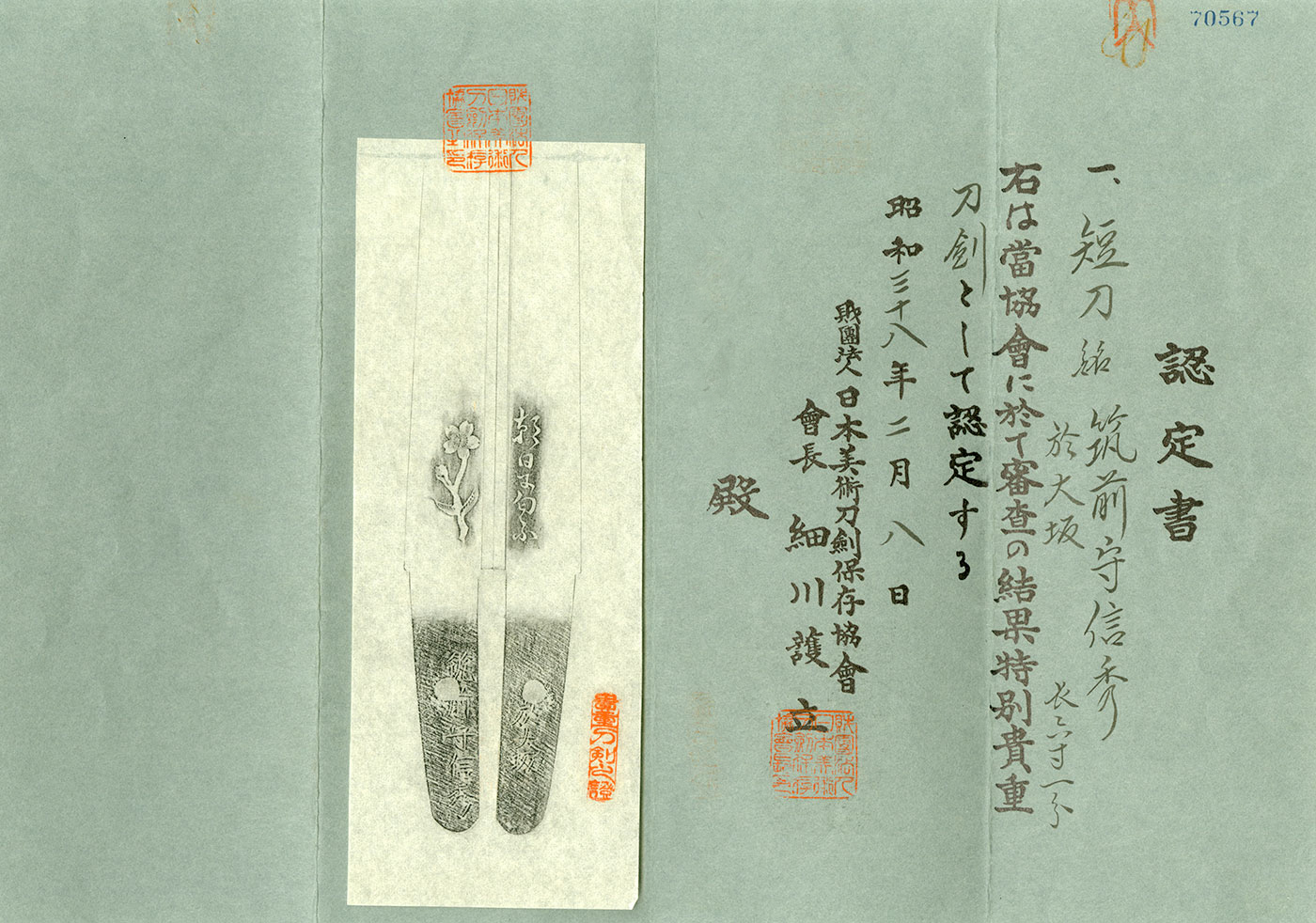
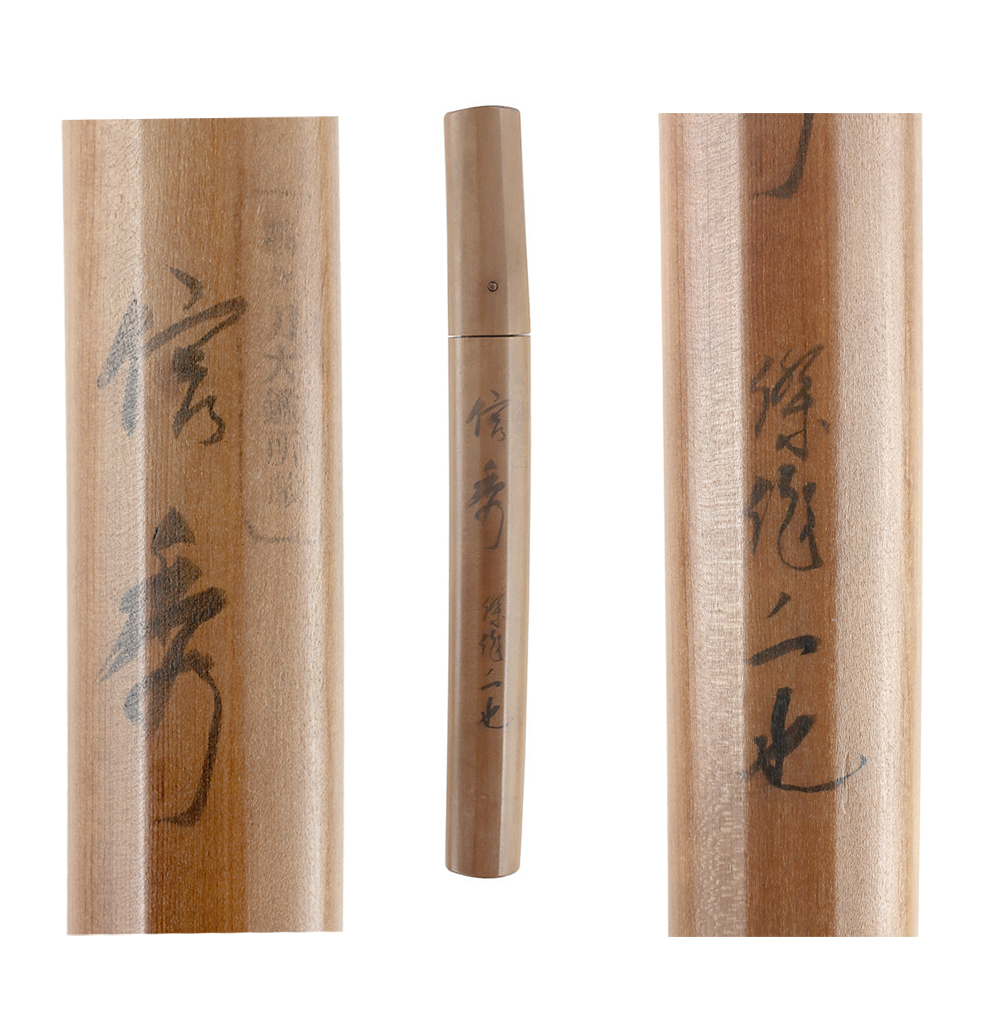
Signature: Chikuzen no Kami Nobuhide
Made in Osaka
筑前守信秀
於大阪
(We divide 4 sections for each sword as Saijyo Saku, Jyojyo Saku, Jyo Saku and Regular Saku).
This blade is ranked as Jyojyo Saku among the works of Chikuzen no Kami Nobuhide.
Habaki: Double-layer gold-covered habaki.
Blade Length: 18.3 cm (7.20 in).
Curvature: None.
Mekugi Hole: 1.
Width at Base (Motohaba): 2.13 cm (0.84 in).
Thickness of rim (Kasane): 0.53 cm (0.21 in).
Sword Weight: 100 g.
Era: Edo period, around the Keio era (1865-1868).
Shape: A slightly small-sized tanto.
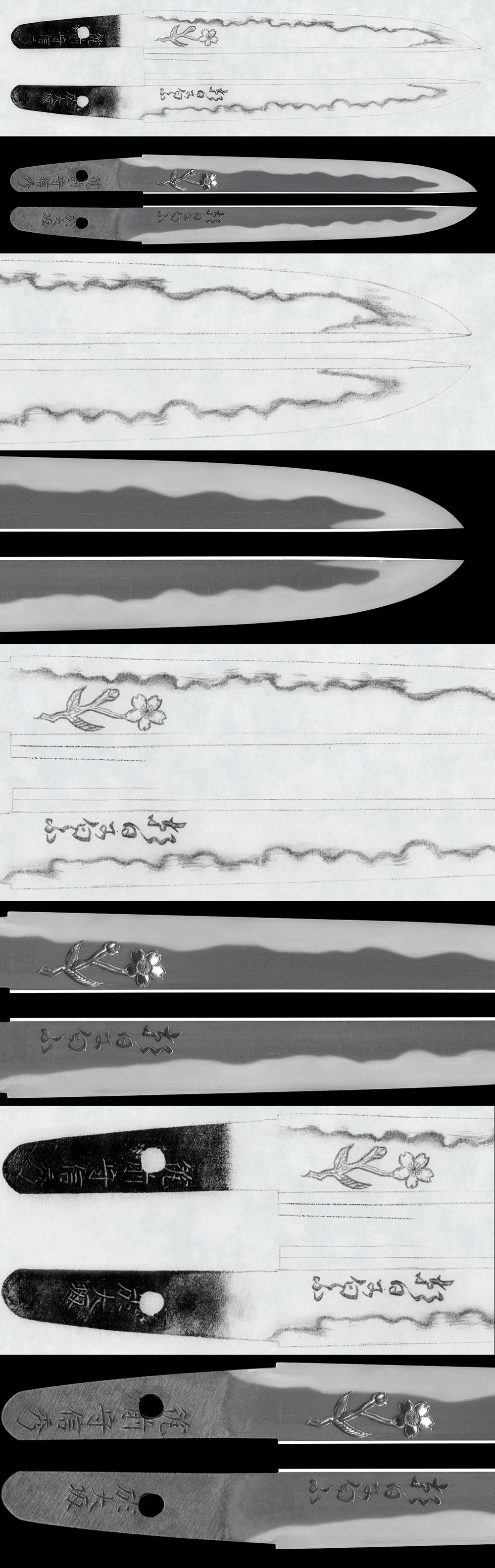
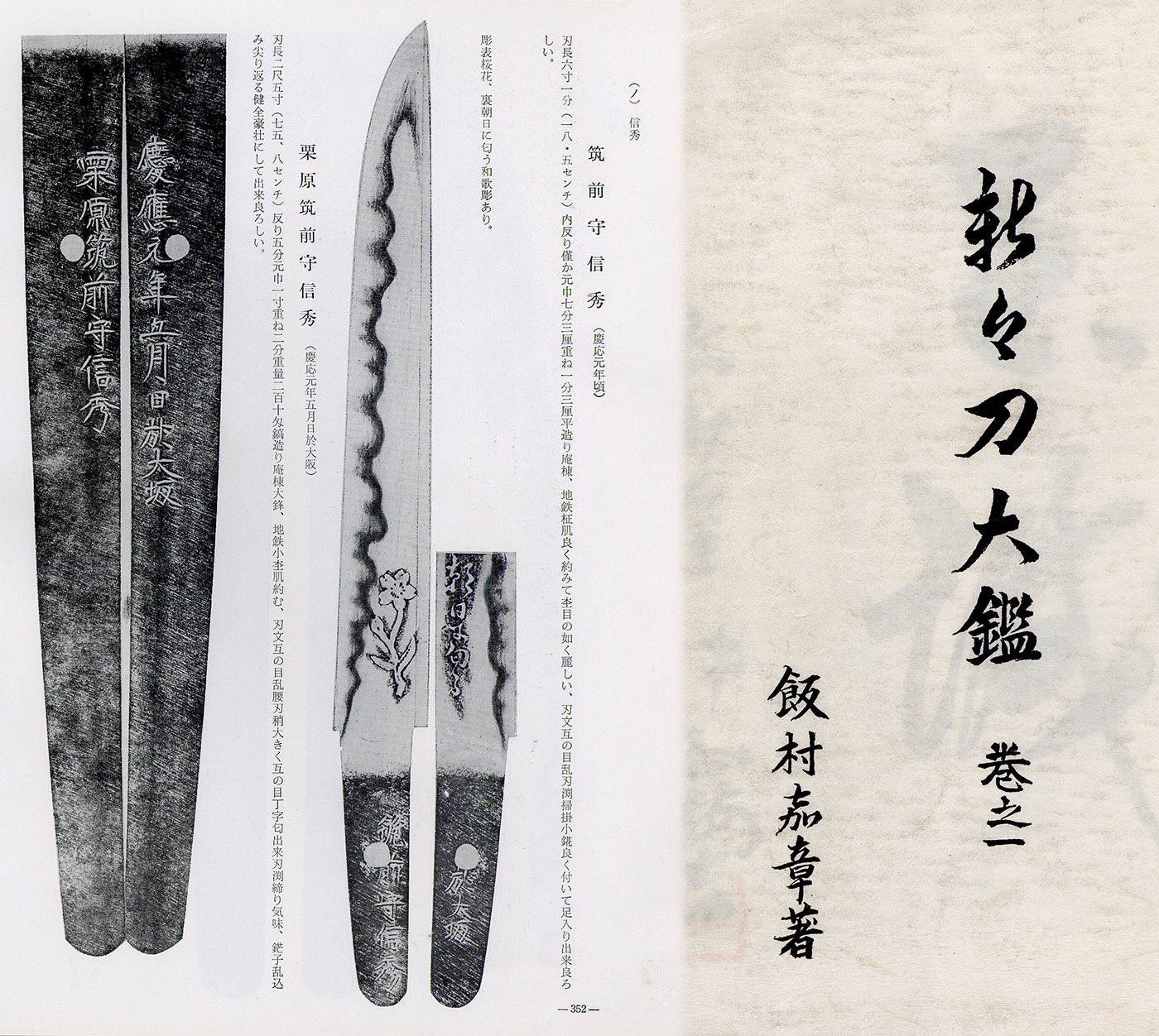
The blade is carved with cherry blossoms and the inscription “Asahi wa Niou” (“The Morning Sun Fragrantly Shines”). Horimono Nobuhide is a different smith.
Jigane: Well-forged masame-hada, producing an almost plain surface.
At first glance it appears to be ko-itame, but the tightly packed masame grain becomes apparent.
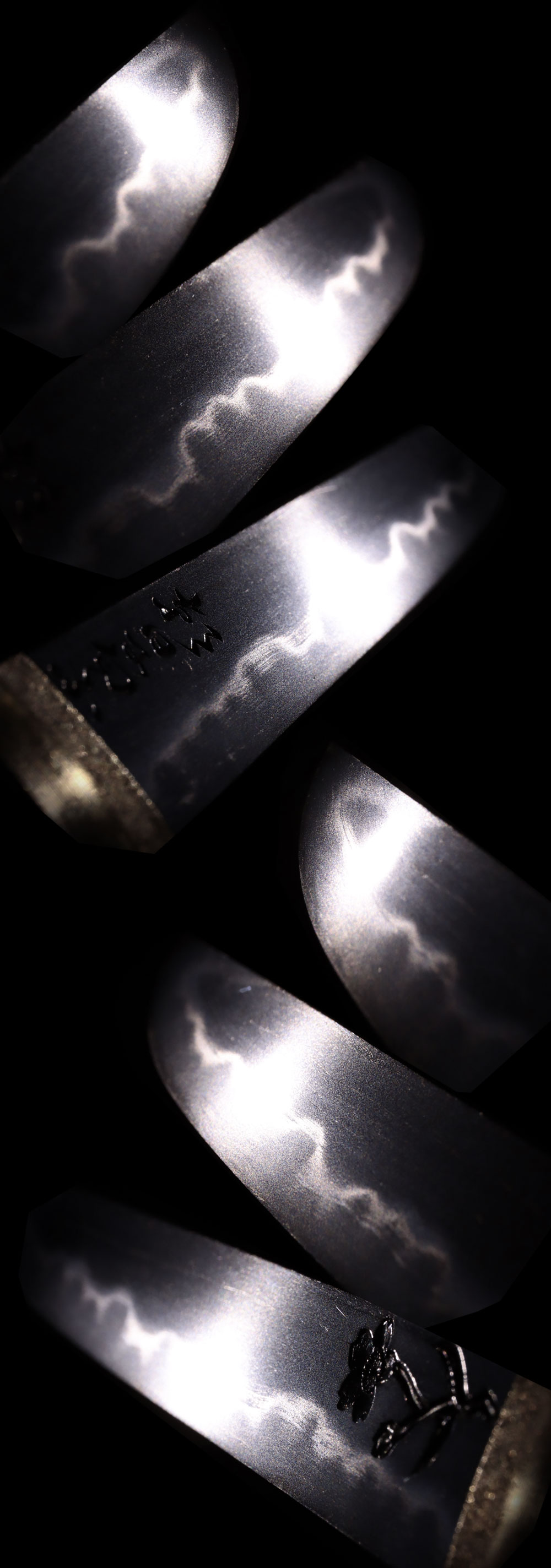
Hamon: Nie-deki, returning in a pointed Samonji-style boshi.
Sunagashi and kinsuji are actively present in places.
Features: Chikuzen no Kami Nobuhide was born in Bunka 12 (1815) in Tsukigata Village, Nishihara District, Echigo Province.
In Bunsei 12 (1829) he went to Kyoto and became a mirror maker, but in Kaei 3 (1850) he moved to Edo and entered the school of Kiyomaro.
After becoming independent, he worked in Uraga, Sagami Province, in Kaei 6 (1853).
In Keio 1 (1865) he went to Kyoto, received the title of Chikuzen no Kami, and stayed in Osaka.
His sword production there began in October 1865 and continued until January 1867.
He later returned to Edo, and in the summer of 1874 he went back to Sanjo in Echigo.
The following year he produced a sacred mirror for Yahiko Shrine.
He died on January 25, 1880, at the residence of his adopted son Nobuchika in Motomachi, Hongo, Tokyo, at the age of 66.
Koshirae: Aikuchi Koshirae.
Fuchikashira / Kojiri / Kurikata: Shibuichi ground carved with wave designs.
Signed: Kasan saku, Masanaga koku.
Saya (Scabbard): Decorated with gold and vermilion patterns, with a turtle rendered in gold maki-e.
Menuki: Cranes in high relief on shakudo ground with gold iroe.
Kozuka: Silver ground carved with cranes and waves.
Signed: Kasan.
Historical Background: Works by Chikuzen no Kami Nobuhide featuring horimono are most commonly seen from the Meiji period onward.
Even after the Haitōrei (Sword Abolishment Edict), Nobuhide continued to produce swords, and it is believed that Meiji 10 (1877) marks the latest dated example bearing both signature and date.
By this time, government regulations had likely become increasingly strict.
Later, during the conflict between Japan and Russia, permission was granted once again for the production of Japanese swords.
As is well known, many swordsmiths, including Gassan Sadakazu, actively resumed sword making.
This particular work is illustrated on page 352 of Shinshinto Taikan.
Detailed full-length photographs are also published there.
The nioiguchi is deep and kinsuji are clearly visible.
This is an outstanding work by Chikuzen no Kami Nobuhide, the most famous disciple of Kiyomaro.
This blade also retains its original cutting edge.
NBTHK Tokubetsu Hozon Token.
NBTHK Tokubetsu Kicho Token.
AoiArt estimation paper: Whole Oshigata.
Please note: the price does not include the shipping fees.


Starting bid: ¥1,350,000
|
Auction started
2026/06/17 (Wed) 11:01 |
※ = Auto