
 日本語
日本語Bid History
|
Auction started
2026/04/09 (Thu) 12:27 |
※ = Auto
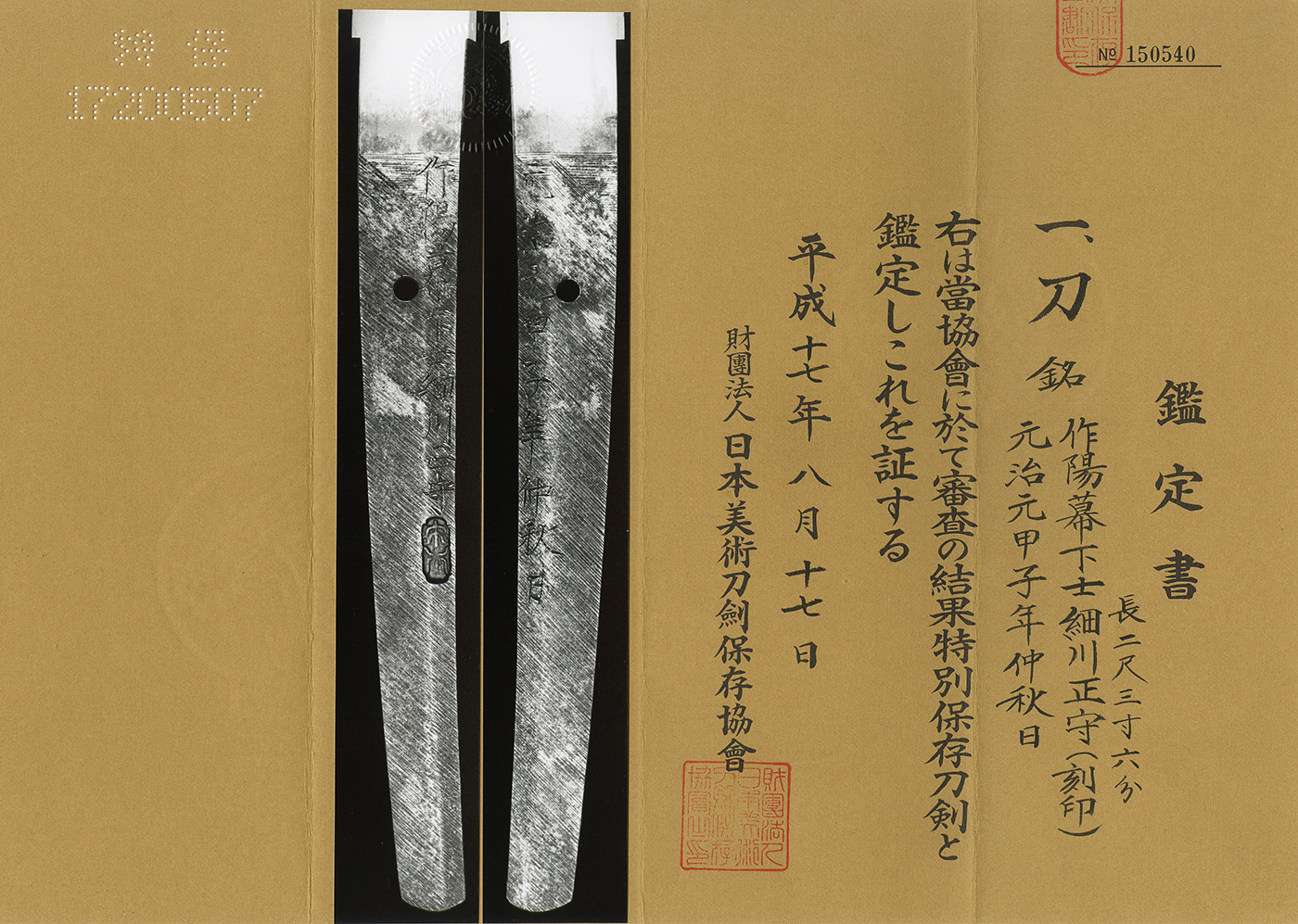
Katana in Shirasaya(NBTHK Tokubetsu Hozon Token)
Signature:
Sakuyō Bakka-shi Hosokawa Masamori withe a stamped mark.
作陽幕下士細川正守
Genji Gan Kou-shi nen Chushu Bi (Mid-Autumn day, 1864)
元治元甲子年中秋日
(We divide 4 sections for each sword as Saijyo Saku, Jyojyo Saku, Jyo Saku and Regular Saku).
The workmanship of this piece is ranked as Jyojyo Saku for Hosokawa Masamori.
Habaki: Gold-plated double habaki.
Blade Length: 71.4 cm (28.11 in)
Curvature: 1.4 cm (0.55 in)
Mekugi Hole: 1
Width at Base (Motohaba): 3.34 cm (1.31 in)
Width at Tip (Sakihaba): 2.46 cm (0.97 in)
Thickness of rim (Kasane): 0.77 cm (0.30 in)
Sword Weight: 940 g
Era: the late Edo period (1864)
Shape: wide blade with big kissaki. The ububa remains.
Jigane: packed and fine Jigane with much Jinie attached, and Chikei works well.
Hamon: Nie-deki, Choji and Gunome midare with Ashi, Yo and long and frequent Sunagashi. Nioikuchi is thich and somewhat subdued.
Features:
Shinshinto: Chujo-saku: Musashi.
Hosokawa Masamori was the son of Hosokawa Masayoshi, and like his father, he inscribed “Sakuyō Bakka-shi” along with a stamped mark. The tang also shares the characteristic of having bold and clearly carved file marks.
This work is particularly excellent for its bright jigane and rich activities in the hamon. It is in healthy condition and retains its original cutting edge (ubu-ba).
Koshirae:
Tsuba: iron base, carved with a river and water birds.
Inscription: Myochin Soshu (non guaranteed)
Fuchikashira: iron base carved with a design of pinetrees.
Menuki: a design of plants.
NBTHK Tokubetsu Hozon Certificate
AoiArt estimation paper: Whole Oshigata.
Please note: the price does not include the shipping fees.





Starting bid: ¥1,600,000
|
Auction started
2026/04/09 (Thu) 12:27 |
※ = Auto