
 日本語
日本語Bid History
Auction has expired
Auction Expired because there were no bids|
Auction started
2026/01/10 (Sat) 17:10 |
※ = Auto
Ordering number:AS25699
Katana in Shirasaya (NBTHK Tokubetsu Hozon Token)
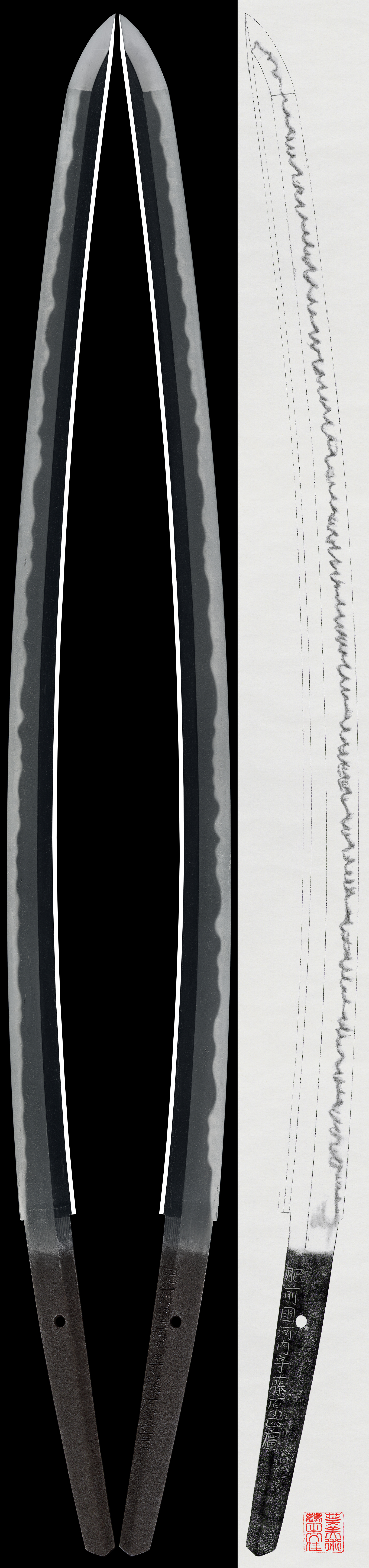
Signature: Hizen Kuni Kawachi no Kami Fujiwara Masahiro
肥前国河内守藤原正広
(We divide 4 sections for each sword as Saijyo saku, Jyo-jyo saku Jyo saku and regular saku)
This sword belongs to Jyo Jyo Saku ranking.
Habaki: Gold foil single Habaki.
Blade Length: 71.4 cm (28.11 in).
Curvature: 2.1 cm (0.83 in).
Mekugi Hole: 1.
Width at Base: 3.27 cm (1.29 in).
Width at the End: 2.3 cm (0.91 in).
Thickness of Rim (Kasane): 0.77 cm (0.30 in).
Sword Weight: 815 grams.
Era: Edo period, Kanbun era.
Shape: The blade has a wide body, thick kasane, and considerably deep curvature, making it a well-proportioned piece. Jigane: Fine Ko-Itame Hada well kneaded into Hizen Hada (Ko-Nuka Hada), becoming an excellent Jigane. Hamon: Gunome Midare with deep Nioiguchi, and the boshi is Midare-komi.
Features: Among Hizen swords, the first and second generation Kawachi no Kami Fujiwara Masahiro consistently produced the highest quality works, known for the most flamboyant Nioiguchi resembling stacked clouds. Kawachi no Kami Masahiro, the son of the first-generation Kawachi Daijo Masahiro, was born in the fourth year of Kan’ei (1627), called Sadanji and initially signed Sadanaga. He died in the twelfth year of Genroku (1699) at the age of seventy-three. His work style includes both Suguha and Midareba, all characterized by deep Nioiguchi. His Gunome Midare is particularly notable as his forte.
Aoi Art’s Comment: The excellence of Hizen swords lies in the quality of their Jigane. The Nabeshima clan exclusively imported Dutch iron and likely mixed it with Japanese iron to create high-quality Jigane, used as skin steel. Bungo swords, from the neighboring region of Kyushu, were made from high-quality steel in the early Shinto period but were thought to be made only from Japanese Tamahagane. This was probably a secret kept only among Hizen swordsmiths, similar to a patent held by the Nabeshima clan. Moreover, the first and second generations of Masahiro created unique blades. Their Gunome Midare, reminiscent of cumulonimbus clouds, suggests the summer sky’s towering storm clouds. Personally, the sight of Gunome Midare, especially large Gunome Midare, excites me. It is a piece I highly regard among Shinto swords. Once, while traveling by train from Nagasaki to Fukuoka, I saw towering mountains and cumulonimbus clouds against the blue sky through the window on the left, a scene that remains vividly in my memory. Although this work is somewhat calmer and different from the cumulonimbus theme, the beauty of its Jigane is remarkable, with excellent Ji-nie and slightly deep Choji with soft legs. The nakago is beautiful, with clear Yasurime, well-cut signature, and one Mekugi-ana, indicating it retains its original edge. It also demonstrates the beauty of its shape, with a deep curvature and an extended kissaki. It is a piece I highly recommend.
NBTHK Tokubetsu Hozon Token.
AoiArt estimation paper.
Whole Oshigata.




Auction Expired
Auction Expired because there were no bids
Auction has expired
Auction Expired because there were no bids|
Auction started
2026/01/10 (Sat) 17:10 |
※ = Auto