
 日本語
日本語Bid History
Auction has expired
Auction Expired because there were no bids|
Auction started
2026/01/10 (Sat) 11:21 |
※ = Auto
Ordering Number: AS25556
Katana in Shirasaya (NBTHK Hozon Token)
Signature: Mumei (attributed to Omura Kaboku)
(Kiri-tsuke Mei): Ken Tanren Gokusei Den Tame Kaho
Fujii Noriaki Bunki Chichi Kore wo Haku
無銘(大村加ト)
(切付銘)乾鍛錬極精伝為家宝
藤井徳昭文熈父佩之
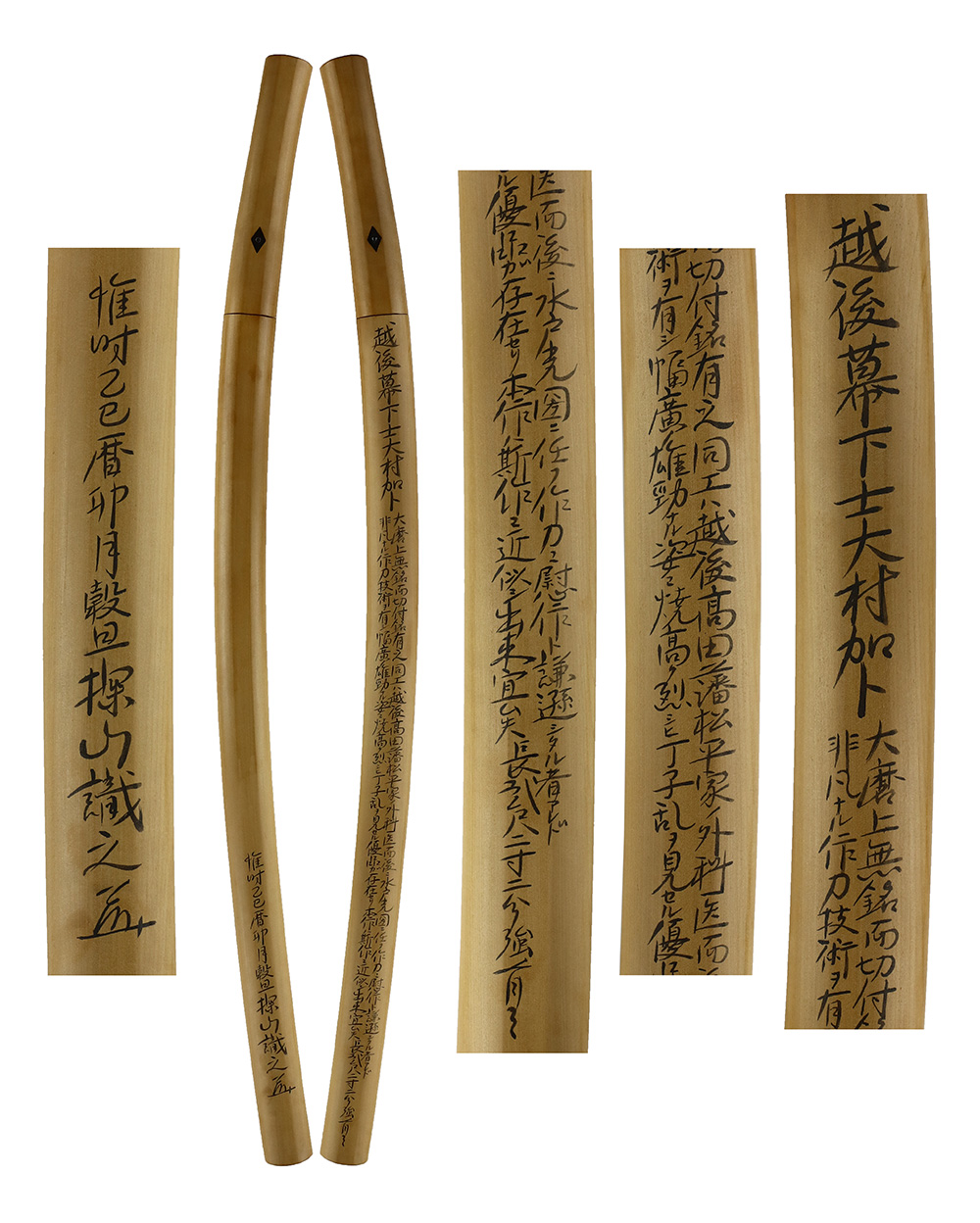
Sayagaki:
Omura Kaboku, a retainer under the Echigo domain, had this sword greatly shortened and re-inscribed.
He originally served as a surgeon for the Matsudaira family of Takada Domain in Echigo and was later appointed to serve Tokugawa Mitsukuni of Mito.
Though some described his sword-making as a mere hobby, he possessed exceptional forging skill.
There exist high-quality works of wide and powerful shape, with wild and vigorous choji midare hamon.
This sword resembles such works.
The blade is slightly over 2 shaku 2 bu (approx. 67.2 cm).
Inscribed by Tanzan with kao.
We divide 4 sections for each sword as Saijyo Saku, Jyojyo Saku, Jyo Saku and Regular Saku.
This work is ranked as Jyojyo Saku for a Mumei (Omura Kaboku) sword.
Habaki: Copper single-layered
Blade Length: 67.2 cm (26.46 in)
Curvature: 2.1 cm (0.83 in)
Mekugi Holes: 3
Width at Base (Motohaba): 3.23 cm (1.27 in)
Width at Tip (Sakihaba): 2.15 cm (0.85 in)
Thickness of Rim (Kasane): 0.68 cm (0.27 in)
Sword Weight: 840 g
Shape:Though the blade has been suriage (shortened), it retains a robust thickness.
It features deep curvature, wide blade width, and an extended kissaki.
The sword has excellent nikuoki (meaty thickness), showing a clamshell-like surface, and is in healthy condition.
Jigane:The jigane is a well-forged, refined ko-itame hada, densely packed.
Hamon:A vigorous choji midare in nie-deki, with yubashiri and tobiyaki appearing on the shinogiji.
The boshi turns back in a rounded shape.
Features:
This is a rare work by Omura Kaboku.
Also known as Omura Saemon-no-Jibu, he originally served as a surgeon under Matsudaira Mitsunaga of the Echigo Takada Domain, and later served Tokugawa Mitsukuni in Mito.
There is an anecdote that he was so impressed by the famed Dojigiri Yasutsuna, which was then in the Takada Domain, that he began forging swords himself.
Although Kaboku claimed to have forged over 100 swords, very few of his works remain.
Due to their popularity even in his time, many forgeries are said to exist.
This piece, while unsigned, has been attributed to Kaboku without doubt, making it historically very valuable.
Mr. Tanobe wrote the sayagaki attributing the sword to Omura Kaboku, and the Japanese Sword Museum reached the same conclusion.
It is a remarkable piece.
Aoi Art’s Comment:
The compilation of Dai Nihonshi was initiated by the second lord of the Mito Domain, Tokugawa Mitsukuni, in 1657 (Meireki 3), and was continued as a domain project until its completion in 1906 (Meiji 39).
It is a vast historical chronicle modeled after Chinese dynastic histories, with work beginning during Mitsukuni’s time as heir.
The project took approximately 250 years to complete.
Fujii Noriaki, who became an adopted son, received this sword from his father and entered the Mito Domain.
He was originally the son of Arao Hisanari, a senior retainer of the Tottori Domain, and became an Edo official of the Mito family.
Adopted into the Fujii family, he served under Tokugawa Mitsukuni and Tsunatomo.
Fujii Noriaki, a talented official, rose through the ranks, becoming Koshogashira, Churo, Obangashira, and by Genroku 6 (1693), attained a stipend of 800 koku as Tairo (chief retainer).
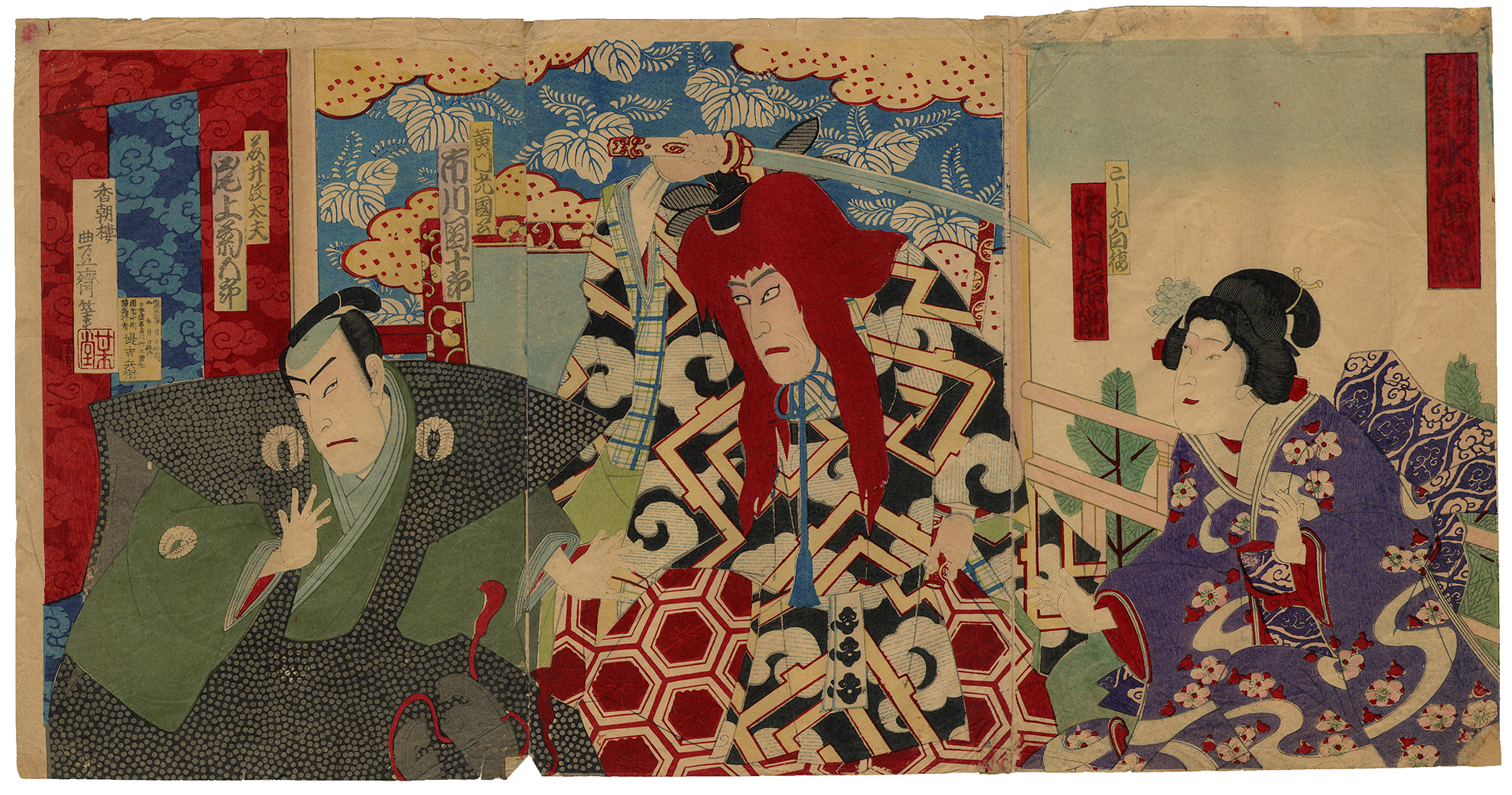
However, during a Noh performance held in the Mito Domain, he was killed by Tokugawa Mitsukuni, likely due to some grave offense.
There are Meiji-era woodblock prints depicting this incident, which help clarify the historical background.
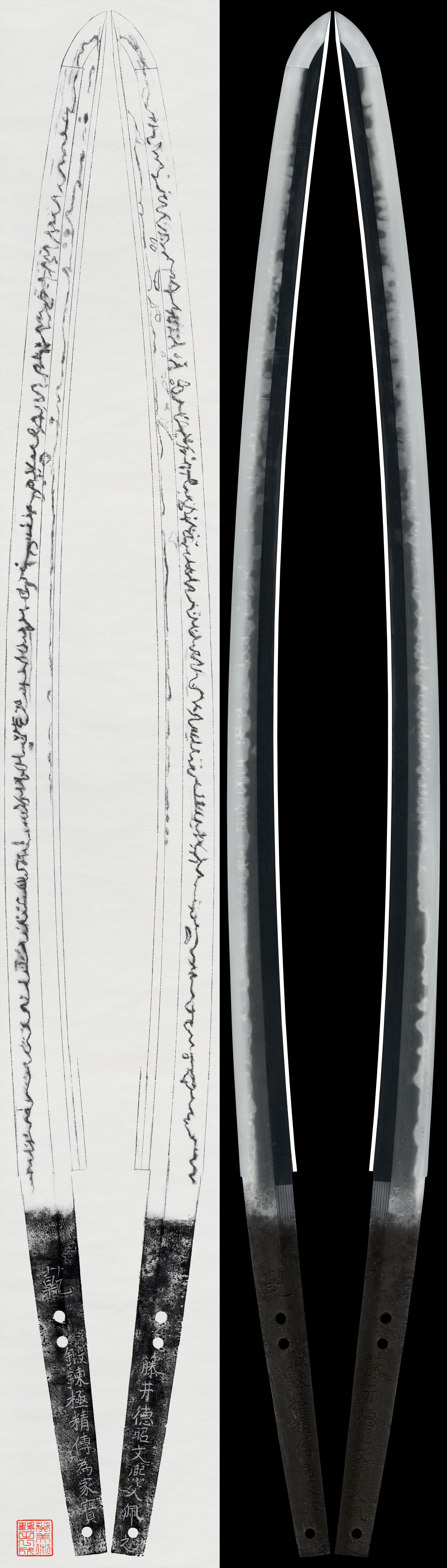
An oshigata (rubbing) of a sword by Omura Kaboku is included for reference.
Please note that although this sword is only accompanied by an NBTHK Hozon Token certificate, in the case of Shinto or Shinshinto period swords with mumei attribution, the Japanese Sword Museum typically only issues Hozon certificates.
We ask for your understanding on this point.
NBTHK Hozon Token Certificate
Whole Oshigata (both sides)
Document(Copy print)
Aoi Art Estimation Paper




Auction Expired
Auction Expired because there were no bids
Auction has expired
Auction Expired because there were no bids|
Auction started
2026/01/10 (Sat) 11:21 |
※ = Auto