
 日本語
日本語Bid History
Auction has expired
Auction Expired because there were no bids|
Auction started
2025/12/02 (Tue) 10:23 |
※ = Auto
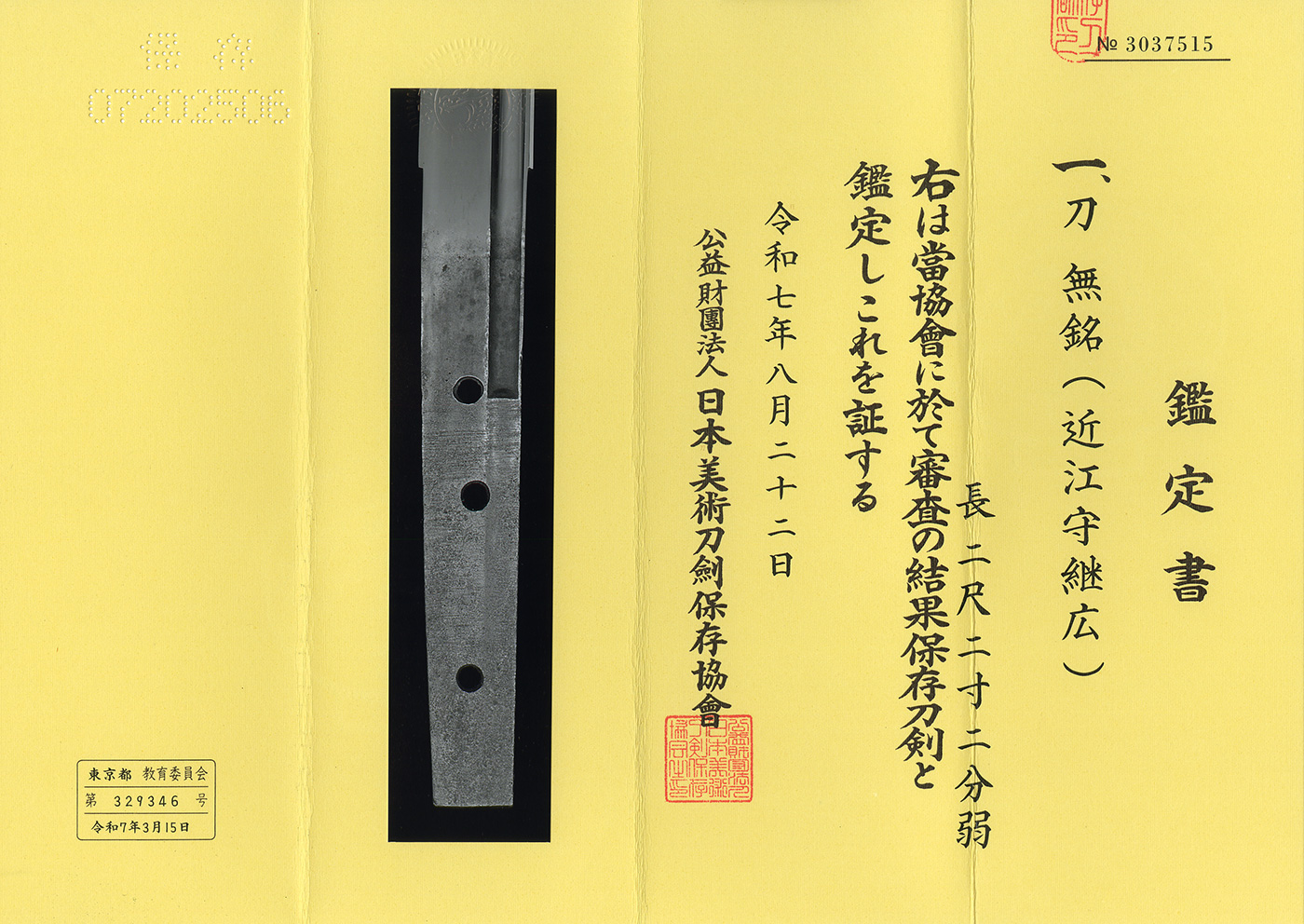
Katana in Shirasaya (NBTHK Hozon Token)
Signature: Mumei (attributed to Omi Kami Tsuguhiro)
:無銘(近江守継広)
Shinto:Chujosaku:Wazamono:Echizen
We divide 4 sections for each sword as Saijyo Saku, Jyojyo Saku, Jyo Saku and Regular Saku.
This blade is ranked as Jyo Saku among works attributed to Mumei (Omi no Kami Tsuguhiro
).
Habaki: Double-layered gold-covered
Blade Length: 67.3 cm (26.50 in)
Curvature: 1.23 cm (0.48 in)
Mekugi Hole: 3
Width at Base (Motohaba): 3.99 cm (1.57 in)
Width at Tip (Sakihaba): 1.99 cm (0.78 in)
Thickness of rim (Kasane): 0.62 cm (0.24 in)
Era: Jokyo era (1684) / Early Edo period
Shape: The blade has a wide mihaba with a slightly shallow sori and is of standard form. It features a bo-hi groove, creating a well-balanced appearance.
Jigane: Ko-itame hada, well-forged with a clear and refined texture.
Hamon: Suguha style with small ashi and a faint utsuri.
Features: It features excellent sharpness.
Omi no Kami Fujiwara Tsuguhiro was a student of the third-generation Yasutsugu of Echizen, and he produced swords in both Omi and Edo.
Many swordsmiths from Mino-Seki had migrated to Echizen Province, and these are collectively referred to as “Echizen Seki.”
Echizen Shinto were especially valued during the late Tokugawa period for their outstanding sharpness and excellence as practical swords.
NBTHK Hozon Token
Aoi Art estimation paper
Whole Oshigata
*Please note: The price does not include shipping fees.
NBTHK Hozon Token
Aoi Art estimation paper
Whole Oshigata
*Please note: The price does not include shipping fees.





Auction Expired
Auction Expired because there were no bids
Auction has expired
Auction Expired because there were no bids|
Auction started
2025/12/02 (Tue) 10:23 |
※ = Auto