Description
Ordering Number: AS24559.
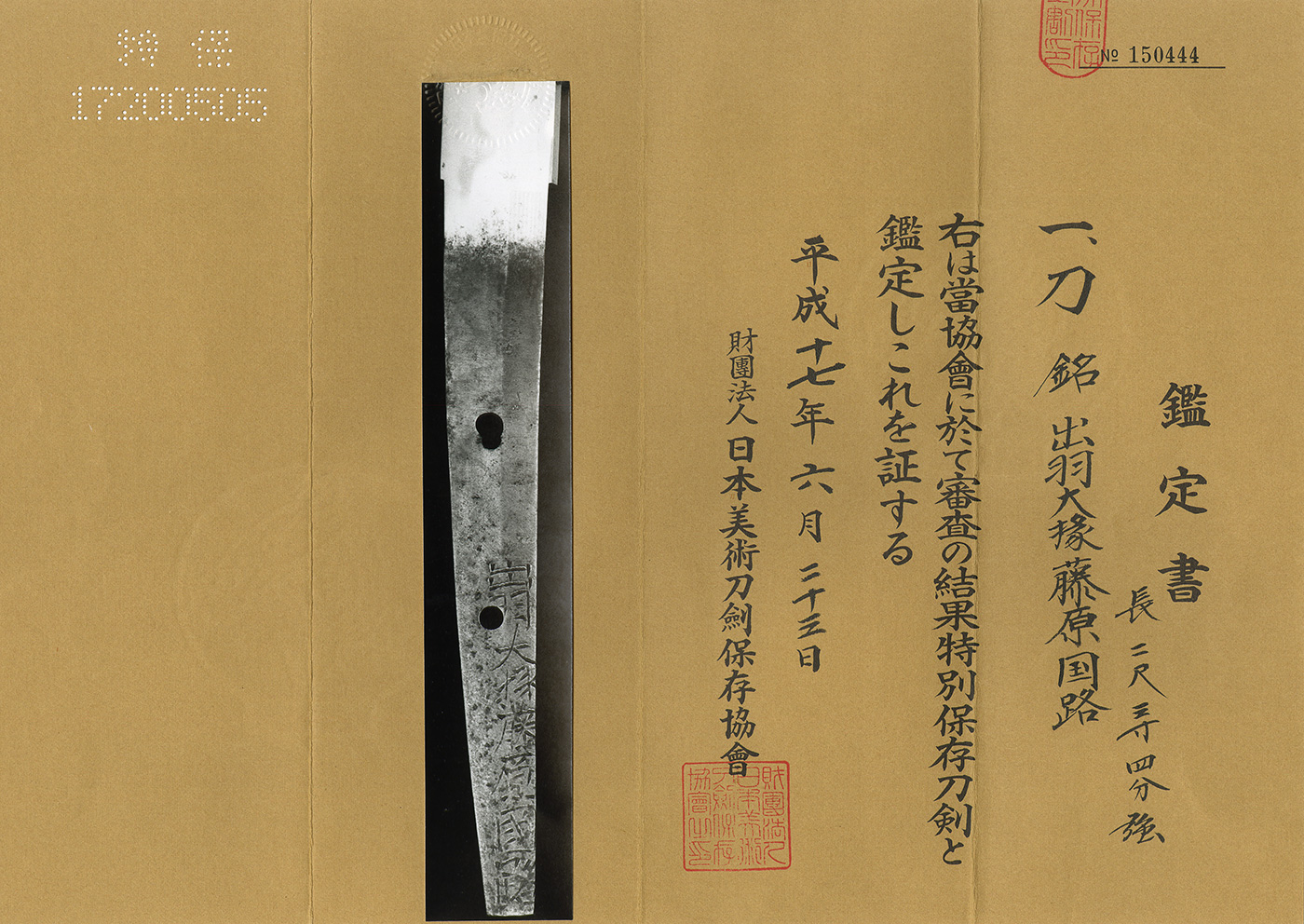
Daisho.
Dai: Katana in Shirasaya with Koshirae (NBTHK Tokubetsu Hozon Token).
Signature: Dewa Daijo Fujiwara Kunimichi.
出羽大掾藤原國路
(We divide 4 sections for each sword as Saijyo Saku, Jyojyo Saku, Jyo Saku and Regular Saku).
The workmanship of this sword is ranked as Jyojyo Saku for Dewa Daijo Fujiwara Kunimichi.
Habaki: Silver single habaki.
Blade Length: 2 shaku 3 sun 4 bu 5 rin.
Curvature: 5 bu.
Mekugi Hole: 2.
Width at Base (Motohaba): 3.11 cm (1.22 in).
Width at Yokote (Sakihaba): 2.03 cm (0.80 in).
Thickness of rim (Kasane): 0.62 cm (0.24 in).
Sword Weight: 795 g.
Era: Edo period, around the Kanbun era (1661–1673).
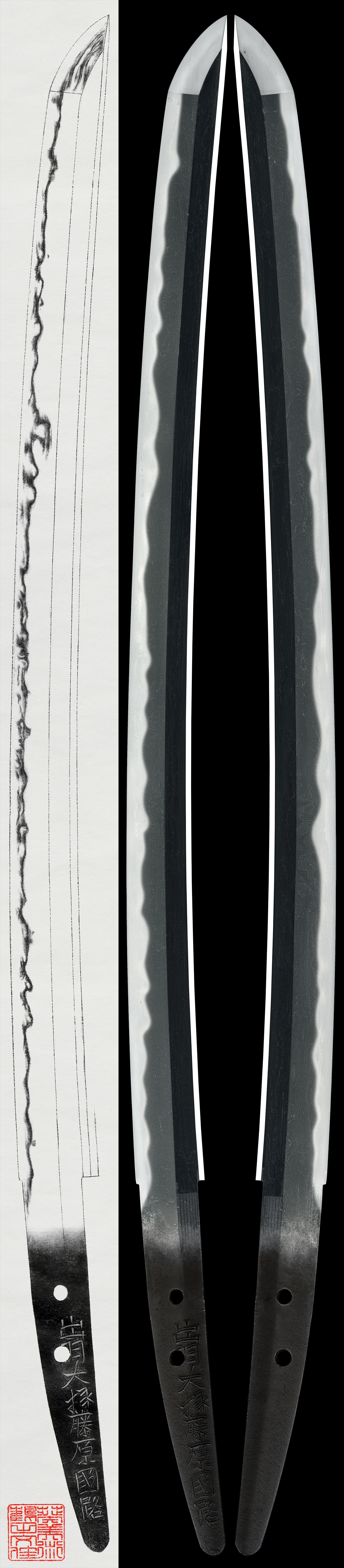
Shape: This blade has been suriage with the machi moved up, but the entire signature remains and is therefore valuable.
It has a wide mihaba, thick kasane, slightly deeper curvature than usual, and an extended kissaki, showing the Kan-ei style sugata.
Jigane: Ko-itame hada with clearly visible grain, forming a refined jigane.
Tobiyaki can also be observed.
Hamon: Nie-deki with a double temper line and a deep nioiguchi.
Within the hamon, sunagashi and kinsuji are actively working.
The boshi returns in the Sanpin style.
Features: A fine work by Dewa Daijo Fujiwara Kunimichi, especially rich in kinsuji and sunagashi, giving the blade a strong and rustic character.
Koshirae:
Tsuba: Vertical oval shakudo polished ground tsuba carved with the twelve zodiac animals. The daisho pair together represents all twelve zodiac signs.
Fuchi: Shakudo nanako ground decorated with Hikyo crest and paulownia crest in gold.
Kashira: Shakudo ishime ground decorated with Hikyo crest in gold.
Saya (Scabbard): Black ishime lacquer saya with Hikyo crest and paulownia crest drawn in black lacquer.
Menuki: Shakudo base with shell and wave design carved and finished with gold coloring.
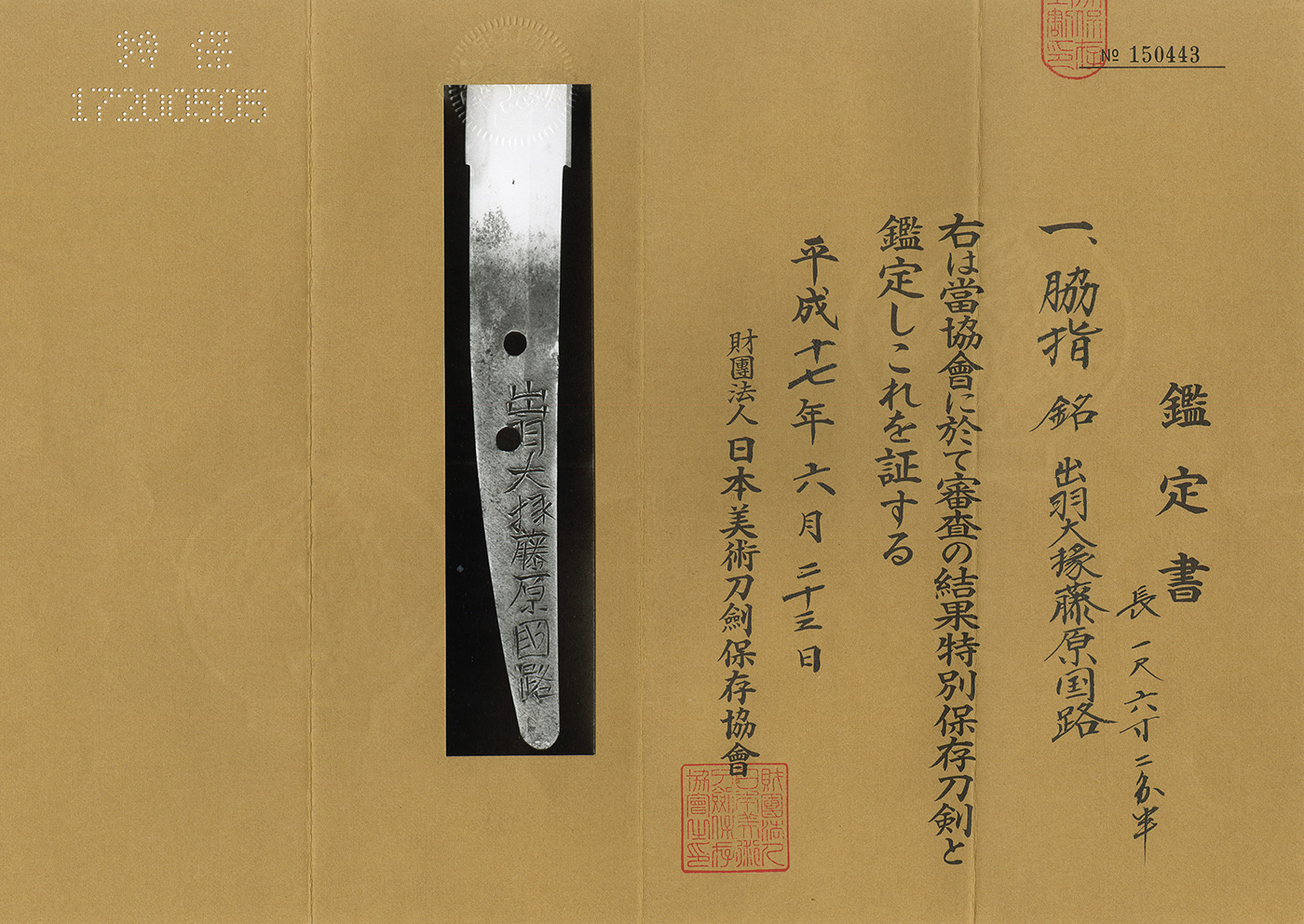
Sho: Wakizashi in Shirasaya with Koshirae (NBTHK Tokubetsu Hozon Token).
Signature: Dewa Daijo Fujiwara Kunimichi.
出羽大掾藤原國路
(We divide 4 sections for each sword as Saijyo Saku, Jyojyo Saku, Jyo Saku and Regular Saku).
The workmanship of this sword is ranked as Jyojyo Saku for Dewa Daijo Fujiwara Kunimichi.
Habaki: Silver single habaki.
Blade Length: 1 shaku 6 sun 3 bu 0 rin.
Curvature: 3 bu 0 rin.
Mekugi Hole: 2.
Width at Base (Motohaba): 2.85 cm (1.12 in).
Width at Yokote (Sakihaba): 2.22 cm (0.87 in).
Thickness of rim (Kasane): 0.60 cm (0.24 in).
Sword Weight: 470 g.
Era: Edo period, around the Kanbun era (1661–1673).
Shape: Although slightly suriage with machi moved up, it remains in healthy condition.
Jigane: Ko-itame hada well forged with clearly visible itame grain.
Hamon: Nie-deki gunome-midare well forged with a deep nioiguchi.
Sunagashi and kinsuji are actively working in the hamon.
Features: A fine work by Dewa Daijo Fujiwara Kunimichi, particularly rich in kinsuji and sunagashi, giving the blade a rustic character.
Koshirae:
Tsuba: Vertical oval shakudo polished ground tsuba carved with the twelve zodiac animals. The daisho pair together represents all twelve zodiac signs.
Fuchi: Shakudo nanako ground decorated with Hikyo crest and paulownia crest in gold.
Kashira: Shakudo nanako ground decorated with paulownia crest in gold.
Saya (Scabbard): Black ishime lacquer saya with Hikyo crest and paulownia crest drawn in black lacquer.
Menuki: Carved figure design with gold coloring.
Kozuka: Shakudo nanako ground with ox design and paulownia crest in high relief with gold coloring.
With kogatana.
Aoi Art’s Comment: Dewa Daijo Fujiwara Kunimichi was the most famous swordsmith among the disciples of Horikawa Kunihiro.
He was born around Tensho 4 (1576) and produced many swords during his long life.
It is believed that he received the title of Dewa Daijo between Keicho 19 and 20 (1614–1615).
The boshi often shows the so-called Sanpin style, where the temper line undulates and returns at the kissaki.
Similar boshi can be seen in works by Etchu Masatoshi of the Kanemichi school, the first generation Tanba, and Iga no Kami Kinmichi.
His jigane often resembles the Soshu tradition, showing a rough texture with prominent grain and flowing masame, similar to the work of Kunihiro.
This daisho set is suriage with the machi moved up, but the signatures remain fully intact, allowing clear identification.
The koshirae is also excellent and very well made.
Both swords show high-quality workmanship and were likely produced in the same period.
It is very possible that they once belonged to a daimyo.
This is a highly recommended set.
Dai and Sho: NBTHK Tokubetsu Hozon Token.
AoiArt estimation paper.
Whole Oshigata.
Overseas shipping fee is not included.


 日本語
日本語