
 日本語
日本語Bid History
Auction has expired
Auction Expired because there were no bids|
Auction started
2026/02/07 (Sat) 10:08 |
※ = Auto
Ordering number:AS25441
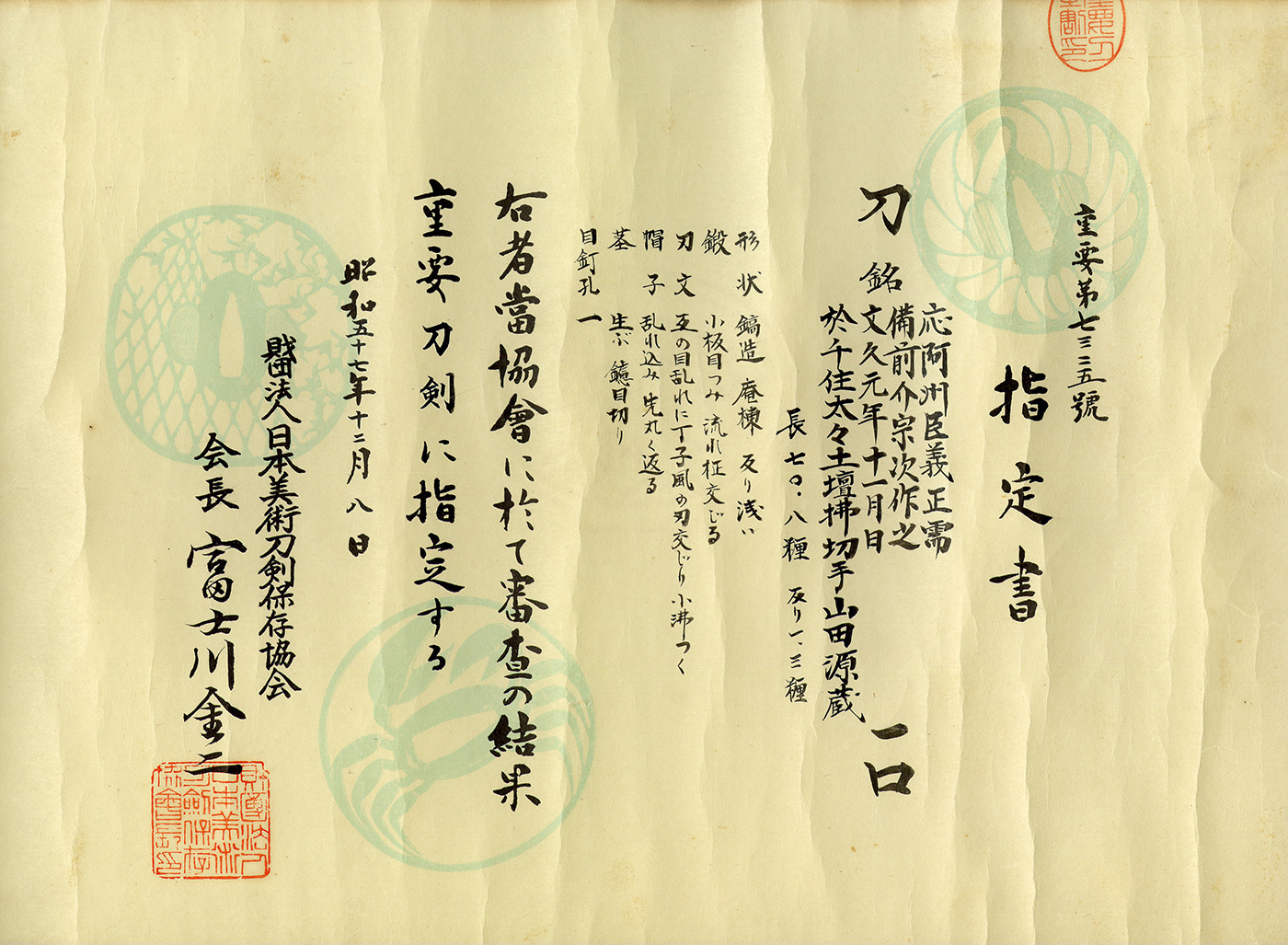
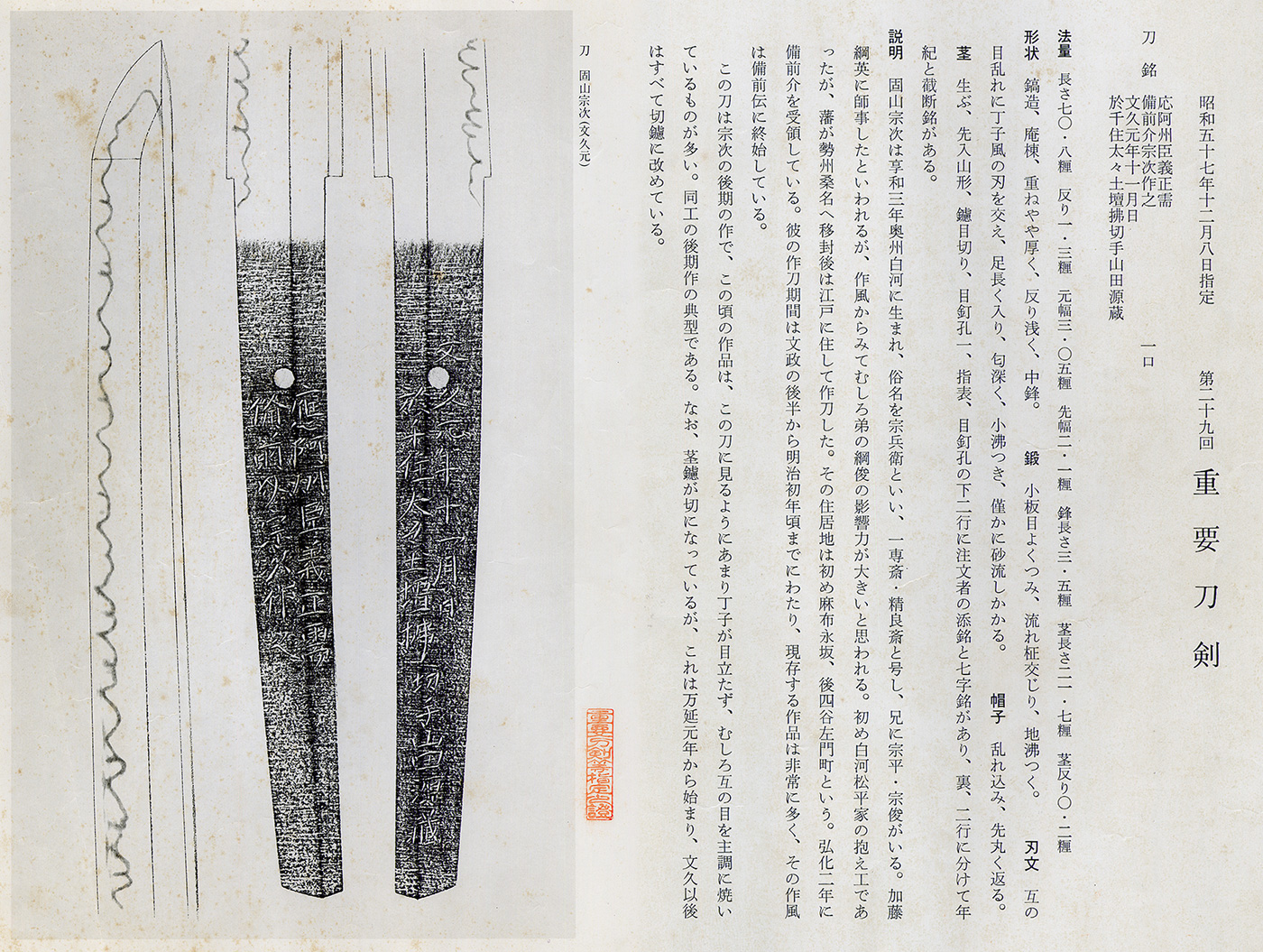
Katana in Shirasaya (29th NBTHK Juyo Token)
Signature: O Ashu Shin Yoshimasa Ju
Bizen Suke Munetsugu Saku Kore
Bunkyū 1 Nen 11 Gatsu Hi (November, 1861)
At Senju, Daitai Dotanbarai Kirite Yamada Genzō
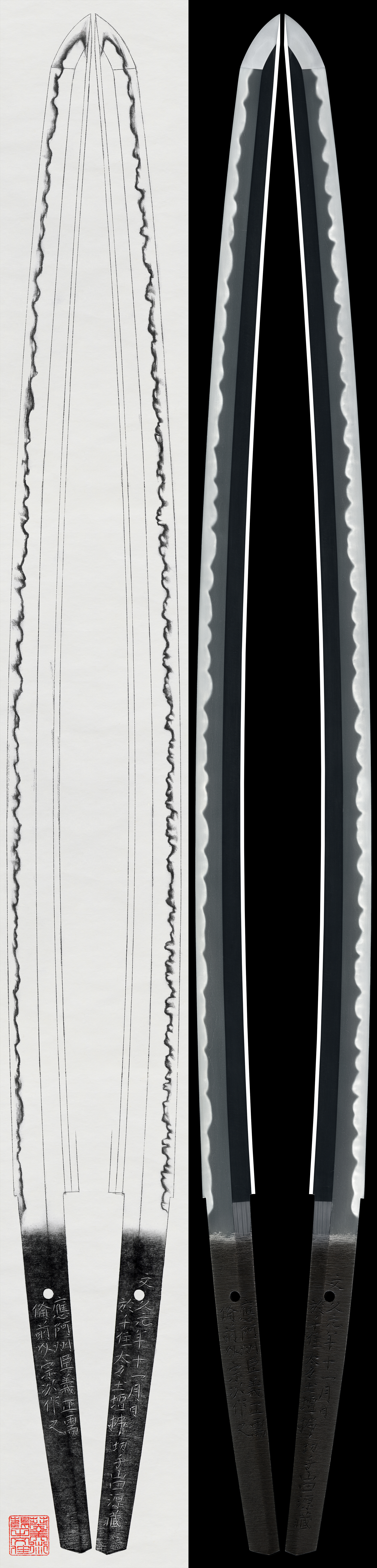
応阿州臣義正需
備前介宗次作之
文久元年十一月日
於千住太々土壇払切手山田源蔵
We divide 4 sections for each sword as Saijyo Saku, Jyojyo Saku, Jyo Saku and Regular Saku.
This work is ranked as Saijyo Saku (highest rank) among the works by Bizen-no-Suke Munetsugu.
Habaki: Double-layered, gold-covered
Blade Length: 70.6 cm (27.80 in)
Curvature: 1.5 cm (0.59 in)
Mekugi Hole: 1
Width at Base (Motohaba): 3.16 cm (1.24 in)
Width at Tip: 2.14 cm (0.84 in)
Thickness of Rim (Kasane): 0.78 cm (0.31 in)
Sword Weight: 930 g
Shape:Wide body, thick kasane, with moderate curvature and an extended kissaki.
Jigane:Finely forged with small itame hada, forming a clear and refined steel.
Hamon:A series of gunome-midare, with a slightly deep nioiguchi, forming a bright and clear temper.
The bōshi curves like Kotetsu and returns roundly.
Features: This sword bears a cutting test inscription, stating that in November of Bunkyū 1 (1861), Yamada Genzō performed a Daitai Dotanbarai cutting test at Senju.
In the late Edo period, gold inlays were rarely used, and instead inscriptions were carved directly onto the tang (nakago).
It is said that Bizen-no-Suke Munetsugu was so meticulous that he never produced flawed works and trained with extreme care.
Aoi Art’s Comment: It is believed that a samurai from Tokushima in Awa Province ordered this sword, and acquiring it must have taken considerable time.
When a cutting test inscription was made, the cutter would receive the liver of the executed person, which would be dried and sold at high prices.
Historical Context: Around the time this sword was made in 1861 (Bunkyū 1), several significant events occurred nearby, such as the Sakuradamon Incident in 1860 and the Namamugi Incident in 1862, marking turbulent transitions in the era.
The formal abolition of the sword-wearing law came in Meiji 9 (1876).
This sword exhibits a bright and clear hamon with soft, flowing ashi, making it a highly recommended piece.
29th NBTHK Juyo Token
Aoi Art estimation paper:whole oshigata
Please note: The price does not include the international shipping fees.




Auction Expired
Auction Expired because there were no bids
Auction has expired
Auction Expired because there were no bids|
Auction started
2026/02/07 (Sat) 10:08 |
※ = Auto