
 日本語
日本語Bid History
Auction has expired
Auction Expired because there were no bids|
Auction started
2026/02/01 (Sun) 15:30 |
※ = Auto
Ordering Number: AS22572
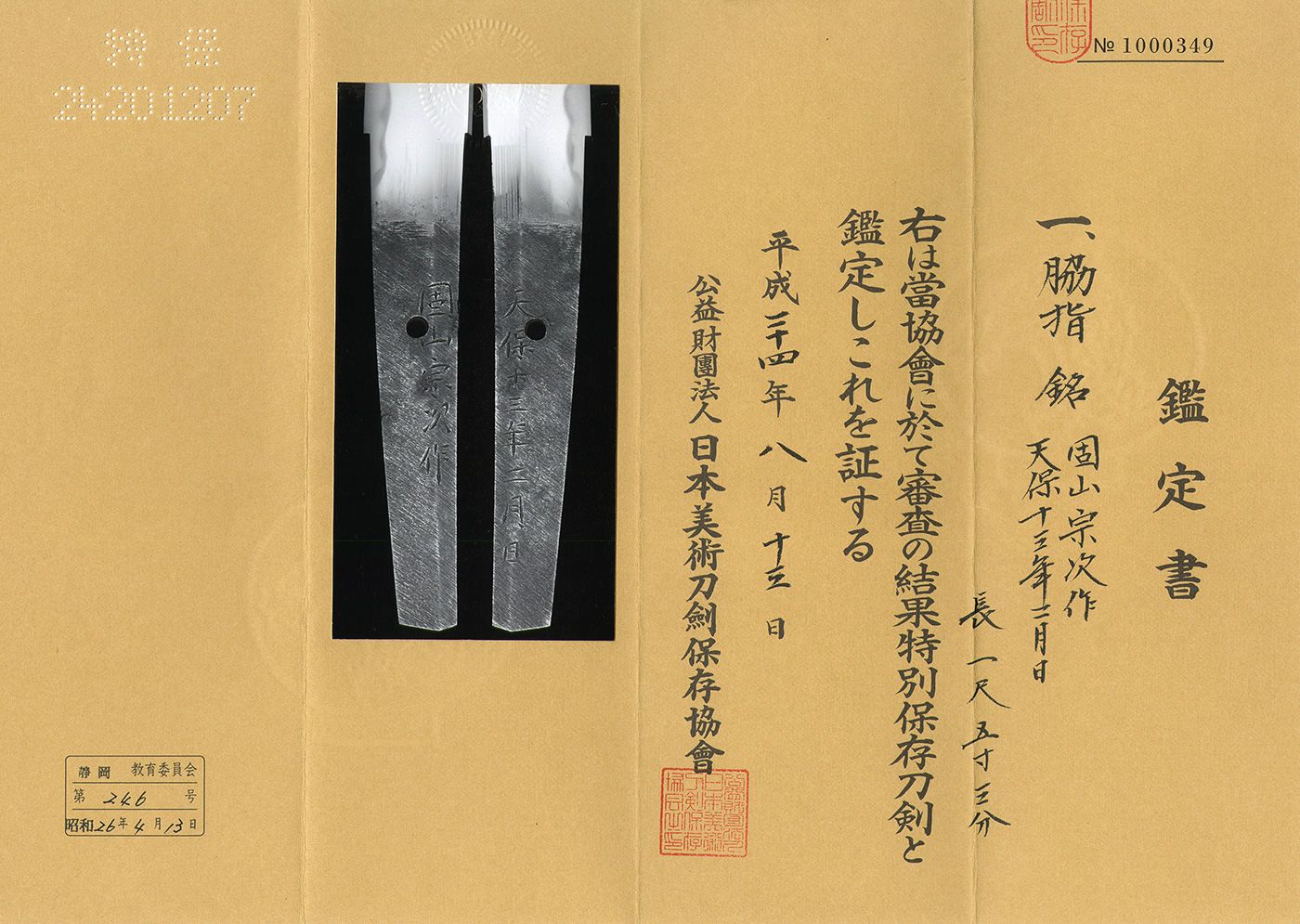
Wakizashi in Shirasaya with Koshirae (NBTHK Tokubetsu Hozon Token) (Tsuba: NBTHK Hozon Tosogu)
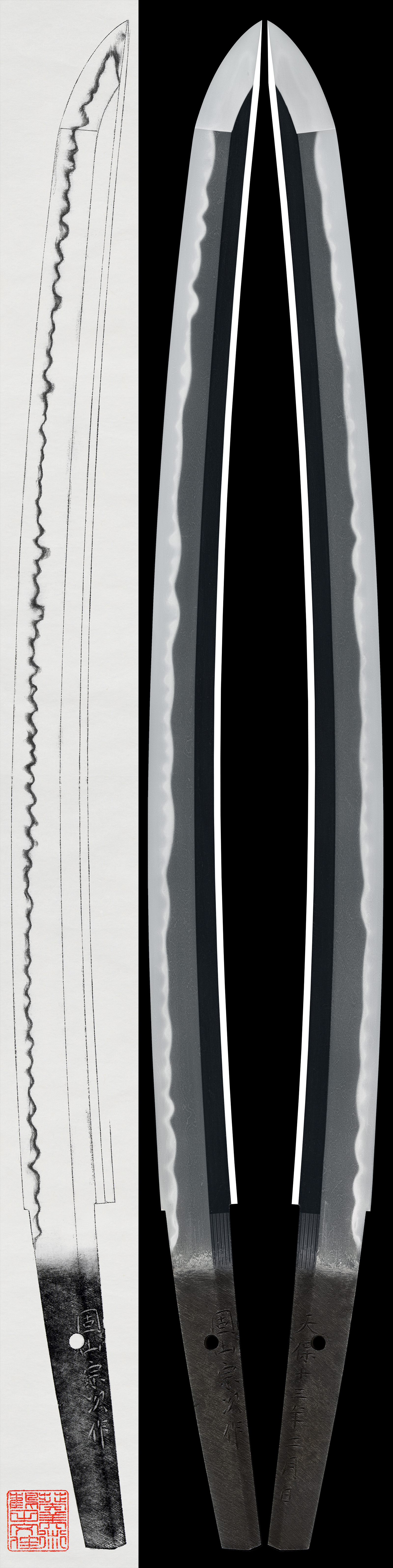
Signature: Koyama Munetsugu
Dated: February, Tenpō 13 (1842)
固山宗次
天保十三年二月日
Shinshinto – Jyojyo Saku – Musashi Province
We divide 4 sections for each sword as Saijyo Saku, Jyojyo Saku, Jyo Saku and Regular Saku.
This work is ranked as Jyojyo Saku among works by Koyama Munetsugu.
Habaki: Single-layered, made of shaku-dō
Blade Length: 43.94 cm (17.30 in)
Curvature: 1.21 cm (0.48 in)
Mekugi Hole: 1
Width at Base (Motohaba): 2.93 cm (1.15 in)
Width at Tip: 2.25 cm (0.89 in)
Thickness of Rim (Kasane): 0.70 cm (0.28 in)
Sword Weight: 475 g
Era: Late Edo period, Tenpō 13 (1842)
Shape:A healthy wakizashi with standard width and thickness, slightly deeper curvature, and an extended kissaki, showing the presence of a ubuha (unsharpened original blade section).
Jigane:A refined mixture of mokume and small itame, with visible chikei, producing a high-quality surface.
The shinogiji consists mainly of small itame mixed with a hint of masame.
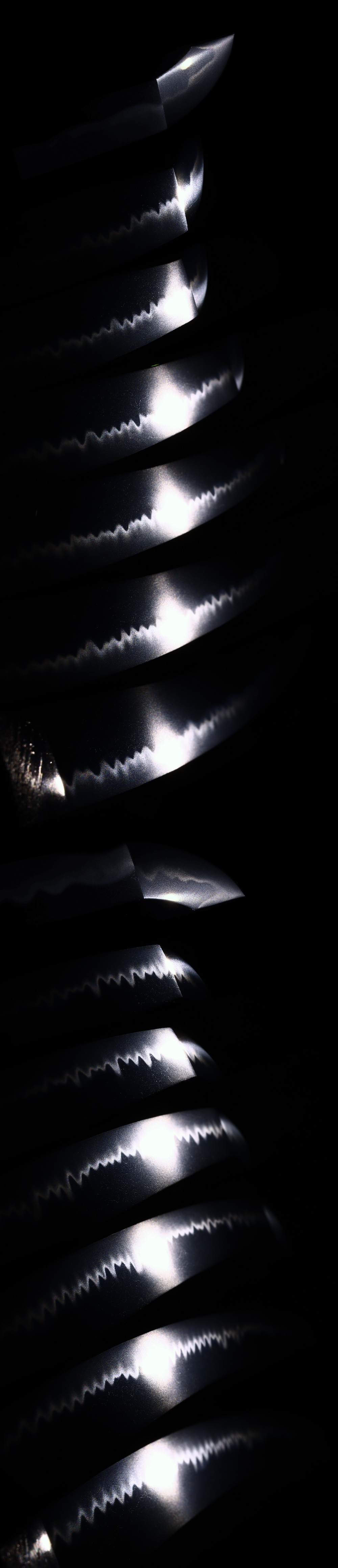
Hamon:Made in ko-nie-deki with a combination of chōji-midare and gunome-midare.
The boshi becomes midare and returns in a small rounded manner (komaru).
Features: Koyama Munetsugu was born in Shirakawa, Ōshū, and was the younger brother of Koyama Muneyuki.
He was a disciple of Katō Tsunaie and used the name Koyama Sōbei.
Later, he moved to Edo and became a swordsmith for the Kuwana Domain.
He resided in Azabu Nagasaka and Yotsuya Samonchō.
He received instruction from Yamada Asaemon in order to enhance the cutting ability of his swords.
He was granted the title Bizen-no-Suke in Kōka 2 (1845) and continued his work into the early Meiji period, retiring with the Haitōrei (sword prohibition decree).
Koshirae:
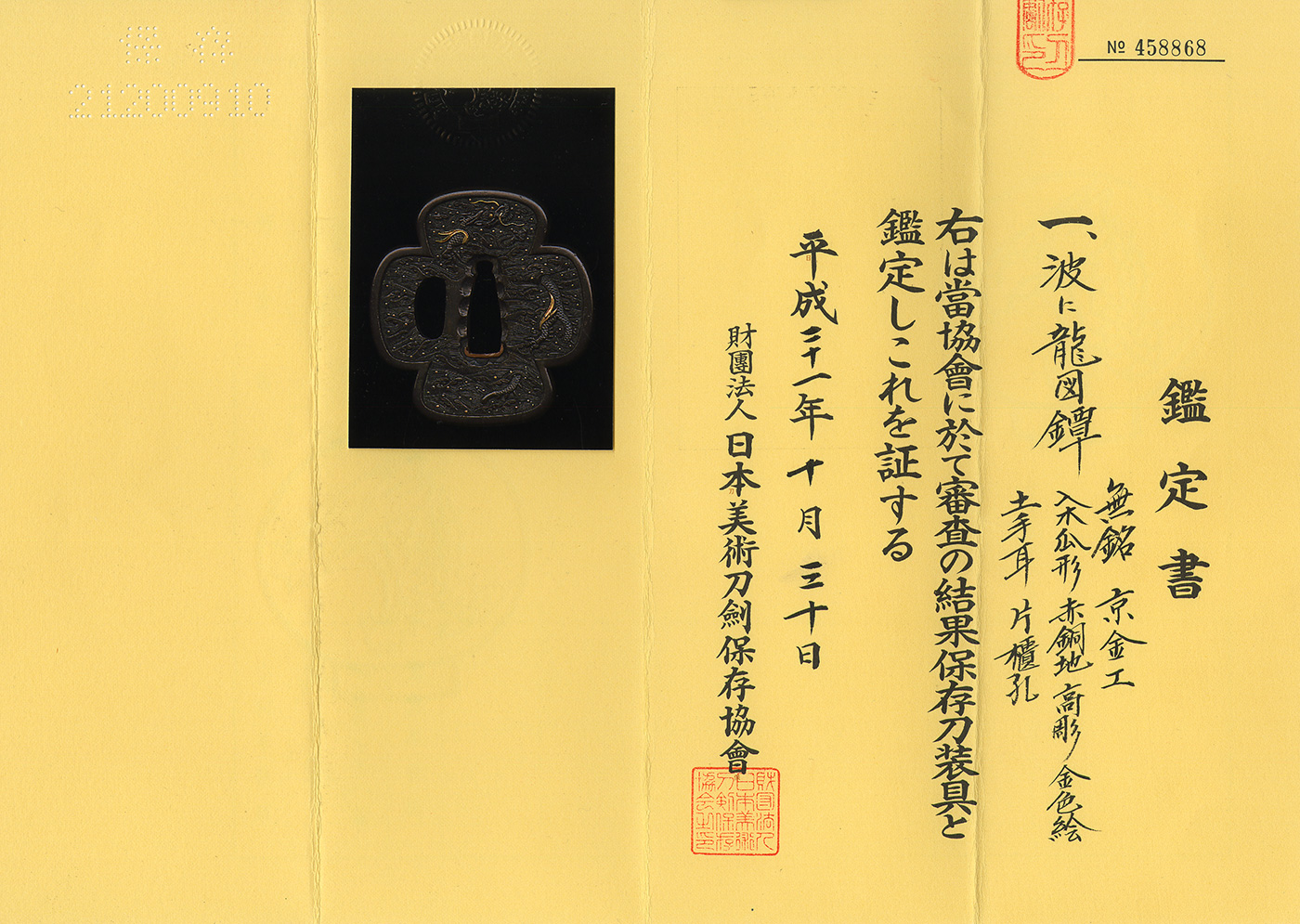
Tsuba: NBTHK Hozon Tosogu, unsigned (Kyō Kinko style).
Mokko-gata shape, made of shaku-dō with high relief carvings of waves and dragons, finished with gold-colored iroe. A heavy and solid work.
Fuchikashira: Shaku-dō with plum motifs, decorated with iroe using suaka and gold.
Saya: Black gloss lacquer saya with grooves.
Menuki: Two lions carved in high relief, with gold-colored iroe.
Kozuka: Shaku-dō with stone-like texture, carved with a human figure, finished with gold iroe.
Comes with small utility knife (kogatana).
Aoi Art’s Comment: Koyama Munetsugu was a swordsmith known for producing flawless blades.
It is believed he would discard any blade with flaws immediately.
He dedicated himself to the Bizen-den tradition and did not work in the Sōshū-den style, which reflects his focused character.
He became the official smith for the Kuwana Domain after moving to Edo, where he resided in Azabu Nagasaka and Yotsuya Samonchō.
He is said to have received instruction from Yamada Asaemon to enhance his swords’ cutting performance, and thus many of his works are associated with test cutting.
He strictly adhered to Bizen-den, producing dignified swords in that tradition.
Interestingly, swords forged during the Tenpō era (like this one, made in Tenpō 13) often display excellent craftsmanship, and Koyama Munetsugu is no exception.
It is curious why so many outstanding blades were produced during this specific period.
This particular piece, forged in the Tenpō era, is an excellent example, and its koshirae is fitted with fine quality kodogu.
Highly recommended.
Historical Background: The Tenpō era in the late Edo period was a time when high-quality steel may have been produced, and demand for Japanese swords increased.
Consequently, many swords of excellent quality were made.
It’s almost puzzling how consistently high the craftsmanship was during this time.
NBTHK Tokubetsu Hozon Token Certificate
Tsuba: NBTHK Hozon Tosogu Certificate
Aoi Art estimation paper and whole oshigata
Please note: the price does not include the shipping fees.




Auction Expired
Auction Expired because there were no bids
Auction has expired
Auction Expired because there were no bids|
Auction started
2026/02/01 (Sun) 15:30 |
※ = Auto